Oil & Gas Safety Management Software

Oil and gas is consistently one of the highest-fatality industries in the United States, with process safety failures, struck-by incidents, H2S exposures, and falls from elevation driving the majority of serious injuries and deaths. The TRIR for oil and gas extraction runs nearly double the all-industry average. The platforms that actually move that number are the ones field personnel, safety coordinators, and HSE managers will use at the wellsite, on the platform, and in the refinery, not just at a desk. 

EHS Insight is that platform. We help upstream, midstream, and downstream operators standardize JHAs and stop-work authority workflows, run permit-to-work processes from a phone, manage contractor prequalification for ISNetworld, Veriforce, and Avetta, investigate incidents in hours, and produce the audit-ready documentation that keeps regulators, operators, and insurance carriers satisfied. Trusted by Alyeska Pipeline, Helmerich & Payne, Ensign Energy, MODEC International, and Bristol Bay Industrial across drilling, production, pipeline, refining, and energy generation. 

What You'll Find on this Page 

The oil and gas safety problems EHS Insight is built to solve, how the platform maps to OSHA 1910.119 PSM, API RP 754, and BSEE requirements, how it works across upstream, midstream, and downstream operations, the metrics it tracks (TRIR, DART, Tier 1/2 process safety events, leading indicators), and links to deeper resources on each topic.

Unlock Your Free Access Now
Get My Custom Quote

The Oil & Gas Safety Problem this Software Exists to Solve

HSE leaders in oil and gas are not short on procedures. They're short on field execution, real-time visibility, and documentation that holds up when a regulator, insurer, or operator walks through the gate. An active wellsite, pipeline corridor, or refinery generates more safety data in a single day than most platforms can process in a week: JHAs, PTW approvals, gas readings, lifting plans, toolbox talks, near miss reports, contractor qualifications, chemical exposure logs, inspection records, and the audit trail that proves compliance to OSHA, BSEE, EPA, and your prime contractor's prequalification system.

Most operators are still managing that on a mix of paper, spreadsheets, disconnected apps, and email threads that disappear when a contract ends. The consequences are predictable:

  • Process safety incidents that a management of change review would have caught.
  • Contractor qualification gaps that don't surface until a fatality or a Veriforce audit,
  • Near misses going unreported because the reporting process requires a laptop and a desk,
  • OSHA 300 logs that don't match incident records when an inspection is triggered,
  • EMR creep that costs millions in workers' comp premium and blocks bids with prequalification score minimums,
  • HSE teams spending more time reconstructing documentation than running the safety program.

EHS Insight is built to close that gap. One platform, mobile-first, offline-capable, with the workflows oil and gas HSE programs actually need, from the wellsite to the boardroom.

The Construction Safety Problem this Software Exists to Solve

Built Around the Hazards That Define Oil & Gas Risk

The hazard profile in oil and gas is unlike any other industry. High-pressure systems, toxic and flammable gases, remote locations, rotating equipment, and dense contractor workforces operating under multiple simultaneous permits create a risk environment where leading-indicator management isn't optional, it's the difference between a near miss and a Tier 1 process safety event. Every capability in EHS Insight maps back to controlling these hazards before they produce casualties.

Process Safety & Loss of Primary Containment

Tier 1 and Tier 2 process safety events, defined under API RP 754, are the most consequential safety metric in the industry. EHS Insight tracks PSE classifications, PHA action items, mechanical integrity inspection results, and management of change documentation in one system. Every LOC event feeds root cause analysis and corrective action tracking, so the lessons from one asset reach the rest of the fleet before the next incident.

H2S & Toxic Gas Exposure

Hydrogen sulfide is responsible for more oil field fatalities than any other toxic substance. EHS Insight manages H2S training records and expiration dates, monitors entry permits for high-H2S environments, and links atmospheric readings to the permit record.

Struck-By, Dropped Objects & Lifting Operations

Rig floor incidents, dropped tools, and crane and lifting operations are among the leading causes of fatality in drilling and production operations. Standardize lifting plans, pre-use equipment inspections, rigger qualification records, and dropped object prevention checklists by asset and crew. Observations that flag unsecured loads or unqualified operators flow into corrective actions before the next lift.

Fire, Explosion & Hot Work

Hot work permitting, atmospheric testing, fire watch verification, and equipment isolation records, all attached to the location, crew, and date where the work is happening. Hot work permits walk crews through built-in safety prompts, confirming atmospheric testing was performed, fire control equipment is on hand, isolation steps are in place, and tie each response to the location, crew, and date of the work. The completed permit is timestamped and auditable from the first signature through close-out. The record is timestamped and auditable from the first signature to close-out.

Contractor & Third-Party Workforce Safety

In oil and gas, the majority of fatalities occur in the contract workforce, not the operator's direct employees. EHS Insight manages prequalification status, COIs, EMR documentation, required training records, and site-specific orientations for every contractor crew. Integration with ISNetworld, Veriforce, and Avetta data flows means qualification status is current, not weeks out of date.

  • Related Reading: The Most Dangerous Jobs in Oil and Gas, and How to Manage the Risk
  • Related Reading: API RP 754 Process Safety Performance Indicators Explained
  • Related Reading: Contractor Safety Management in High-Hazard Industries
Construction Compliance Without the Paperwork Drag

OSHA PSM, API RP 754, and BSEE Compliance Without the Paperwork Drag

EHS Insight ships with templates, workflows, and record-keeping built for the regulatory frameworks that govern oil and gas operations across onshore and offshore environments:

  • OSHA 1910.119, Process Safety Management of Highly Hazardous Chemicals (PSM). PHA action items, MOC workflows, mechanical integrity, hot work permits, contractor safety, incident investigation, and compliance audits.
  • OSHA 1910.146, Permit-Required Confined Spaces. Entry permits, atmospheric monitoring records, attendant assignments, and rescue procedure documentation.
  • API RP 754, Process Safety Performance Indicators. Tier 1 and Tier 2 PSE tracking, near miss classification, and leading indicator reporting.
  • BSEE (Bureau of Safety and Environmental Enforcement), Offshore incident reporting, SEMS (Safety and Environmental Management System) documentation, and audit-ready compliance records for OCS operations.
  • DOT Pipeline Safety Regulations (49 CFR Parts 192/195), Inspection records, integrity management documentation, and operator qualification tracking for pipeline operations.
  • ISNetworld / Veriforce / Avetta / ComplyWorks, Contractor prequalification documentation, EMR records, training matrices, and audit support for prequalification system maintenance.

OSHA 300, 300A, and 301 forms are built in. Record an incident, classify it correctly, and the recordable log updates automatically. ITA ready electronic submission exports are available.

How it Works Across Upstream, Midstream, and Downstream Operations

The regulatory obligation is consistent. The field workflow isn't. A drilling crew on a remote pad has different daily EHS touchpoints than a refinery turnaround team or a pipeline integrity inspector. EHS Insight is configurable for all three, from a single enterprise account.

Upstream

Midstream

Downstream

Drilling & completion JHAs, rig-floor inspections, blowout preventer maintenance records, and stop-work authority workflows.

Pipeline right-of-way inspections, operator qualification records, and integrity management documentation.

Refinery turnaround PTW management, PSM element tracking, hot work and confined space permitting, process hazard analysis action items.

H2S monitoring records, contractor crew orientation, and field-level observation programs for remote pad locations.

Environmental incident reporting, and spill response documentation.

Mechanical integrity inspection scheduling, MOC documentation, and capital project safety review records.

Mobile-first, offline-capable, designed for wellsites with no reliable network coverage.

Route-based inspection workflows,

Enterprise rollup across assets, business units, and geographies for board-level HSE reporting.


What EHS Insight Actually Does in Oil & Gas Operations

Incident Management

Incident Management

Incident Management is the most-used module in EHS Insight’s oil and gas customer base, and not by a small margin. In an industry where a single incident can trigger a fatality investigation, BSEE enforcement action, or a contractor prequalification score review, the ability to capture, classify, and investigate fast is the difference between a controlled response and a cascading crisis. EHS Insight captures injuries, illnesses, process safety events, near misses, environmental releases, vehicle incidents, and property damage from any device in the field in minutes. Tier 1 and Tier 2 process safety events are classified per API RP 754 at the point of entry. Built-in OSHA 300, 300A, and 301 forms update the recordable log automatically. Out-of-the-box the module supports several root cause analysis methods including 5 Why and a configurable causal analysis mechanism that can be configured to accommodate rapid cause analysis, TapRoot®, TopSet, Scat, ICAM, BCCA, CFA, and RCA. 

Audit Management
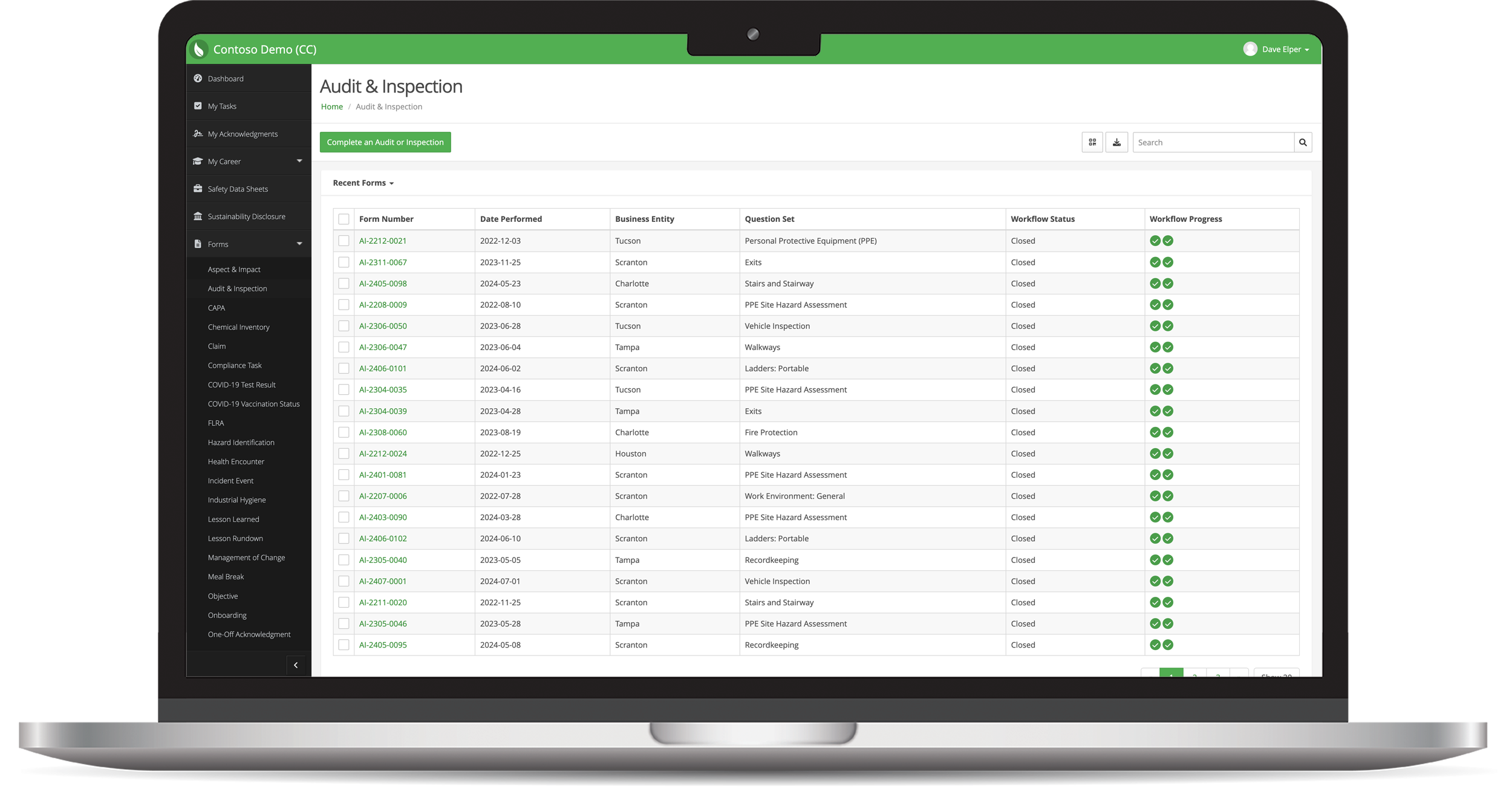
audit-management-module-test

Oil and gas operations face more overlapping audit obligations than almost any other industry, PSM compliance audits, SEMS verifications, ISNetworld and Veriforce third-party reviews, internal asset inspections, turnaround readiness assessments, and regulatory inspections from OSHA, BSEE, EPA, and state agencies. EHS Insight’s Audit Management module runs mobile inspections for wellheads, pressure vessels, lifting equipment, fire suppression, personal gas monitors, PPE, and any other asset or system requiring a documented review. Custom checklists per asset type, location, and regulatory standard. Deficiencies automatically trigger a corrective action with owner, due date, and photo evidence, and overdue findings appear on the dashboard before the next audit cycle arrives. Every completed audit is timestamped, signed, and available for regulator or third-party review within seconds. 

Compliance Task Management

Compliance Task Management

Oil and gas HSE teams manage compliance obligations across more regulatory bodies simultaneously than nearly any other industry. OSHA PSM element reviews, BSEE SEMS audits, EPA Tier II reporting deadlines, DOT pipeline integrity management milestones, state agency permit renewals, and prequalification system updates all run on independent calendars, and every missed deadline carries enforcement exposure. EHS Insight’s Compliance Task module centralizes recurring obligations into a single tracked register. Each task carries an owner, a due date, a recurrence schedule, and an escalation path. Nothing slips because it was in someone’s email inbox. The compliance dashboard shows every open obligation, its owner, and its days-to-due across every asset and business unit, so the HSE director sees the exposure before the deadline passes, not after. 

Work Observations
Work Observations

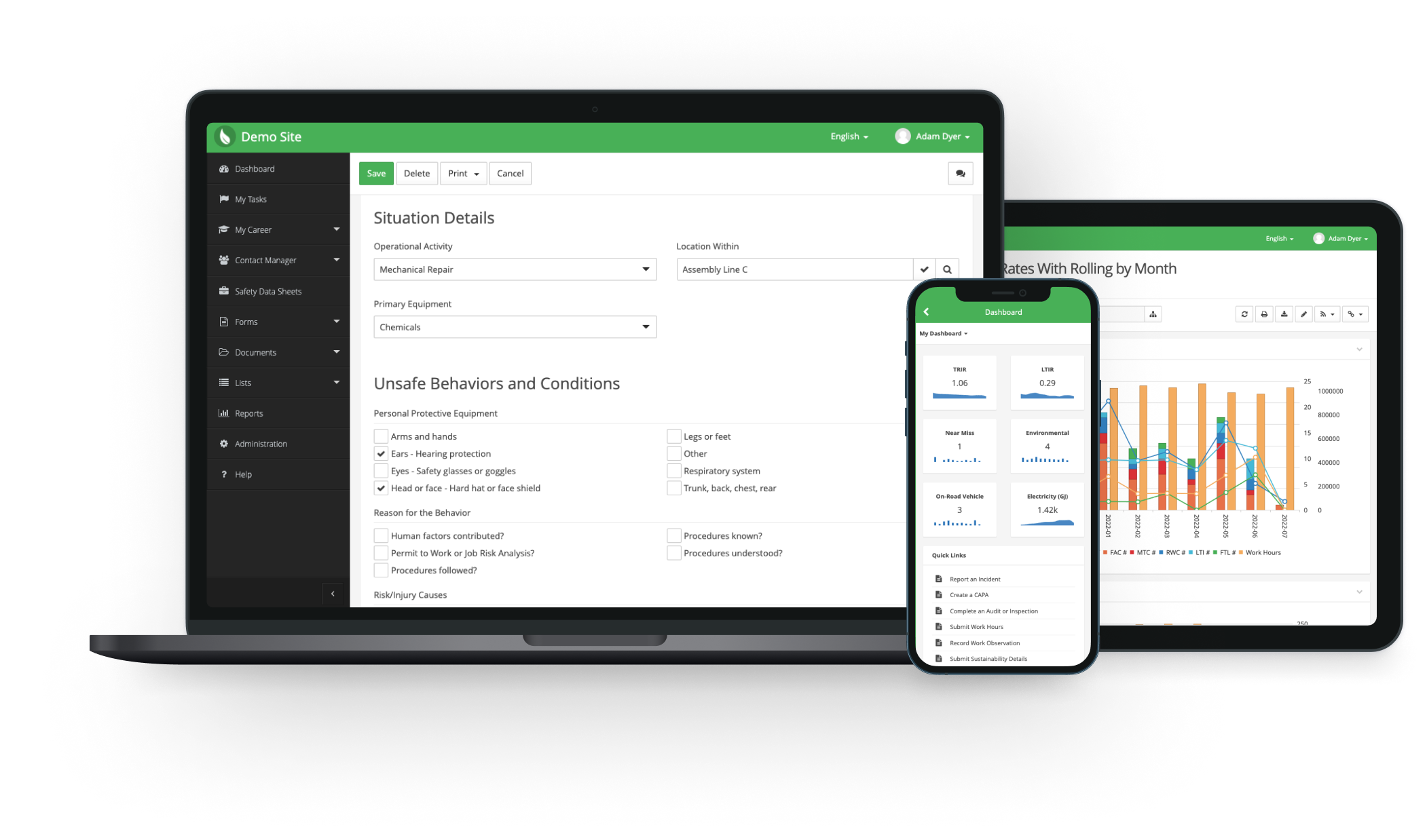
The leading indicator that separates the O&G programs that drive TRIR down from the ones that react after the fact. In dispersed field environments, remote pads, pipeline rights-of-way, offshore platforms, unsafe conditions go unseen for hours or days unless there’s a structured, frictionless way to report them. EHS Insight makes a work observation a 30-second submission from any crew member on any device, anywhere on the asset, safe condition, unsafe condition, safe act, unsafe act, with photo and GPS location attached. Observation data rolls into dashboards that surface patterns across assets, crews, and time periods. The programs using this module consistently see near-miss reporting rates increase as the barrier to submit drops, which is precisely what the API RP 754 Tier 3/4 indicators, and every serious incident review tells you to track. 

Safety Meetings
Safety Meetings

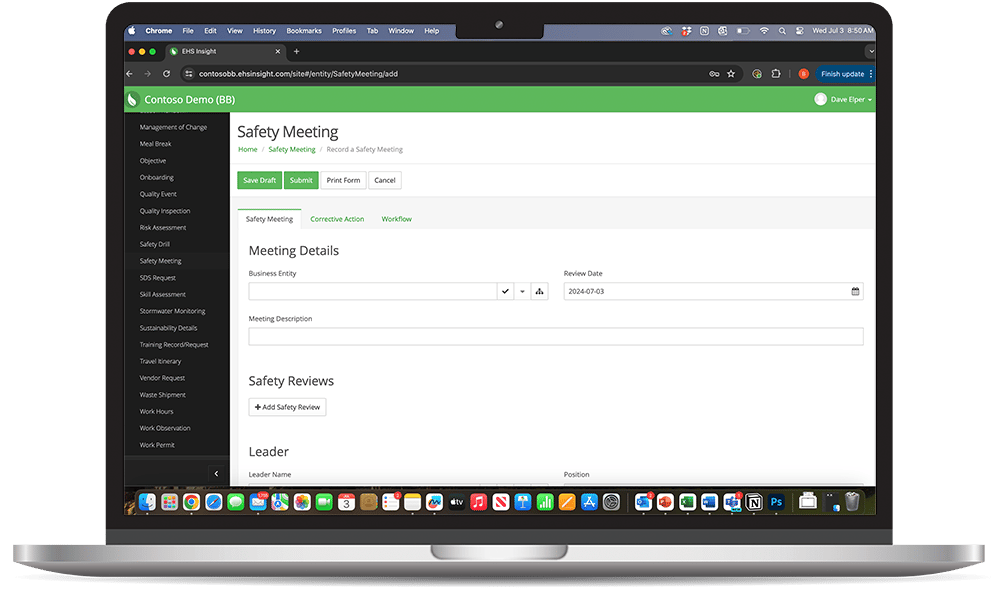
Pre-tour safety meetings and toolbox talks are a daily operational requirement in oil and gas, on drilling rigs, at production facilities, before pipeline maintenance crews start a shift, and at every turnaround kickoff. The problem isn’t running them. It’s proving they happened when a regulator, prime contractor, or insurance auditor asks for the record six months later. EHS Insight logs the meeting topic, attendees, sign-off, and any action items assigned, digitally, from a phone, in real time. Safety meeting completion rates by crew, asset, and shift appear on the dashboard as a leading indicator. The record is timestamped and retrievable in seconds, not filed in a binder somewhere on the rig. 
Incident Management

Incident Management is the most-used module in EHS Insight’s oil and gas customer base, and not by a small margin. In an industry where a single incident can trigger a fatality investigation, BSEE enforcement action, or a contractor prequalification score review, the ability to capture, classify, and investigate fast is the difference between a controlled response and a cascading crisis. EHS Insight captures injuries, illnesses, process safety events, near misses, environmental releases, vehicle incidents, and property damage from any device in the field in minutes. Tier 1 and Tier 2 process safety events are classified per API RP 754 at the point of entry. Built-in OSHA 300, 300A, and 301 forms update the recordable log automatically. Out-of-the-box the module supports several root cause analysis methods including 5 Why and a configurable causal analysis mechanism that can be configured to accommodate rapid cause analysis, TapRoot®, TopSet, Scat, ICAM, BCCA, CFA, and RCA. 

audit-management-module-test

Oil and gas operations face more overlapping audit obligations than almost any other industry, PSM compliance audits, SEMS verifications, ISNetworld and Veriforce third-party reviews, internal asset inspections, turnaround readiness assessments, and regulatory inspections from OSHA, BSEE, EPA, and state agencies. EHS Insight’s Audit Management module runs mobile inspections for wellheads, pressure vessels, lifting equipment, fire suppression, personal gas monitors, PPE, and any other asset or system requiring a documented review. Custom checklists per asset type, location, and regulatory standard. Deficiencies automatically trigger a corrective action with owner, due date, and photo evidence, and overdue findings appear on the dashboard before the next audit cycle arrives. Every completed audit is timestamped, signed, and available for regulator or third-party review within seconds. 

Compliance Task Management

Oil and gas HSE teams manage compliance obligations across more regulatory bodies simultaneously than nearly any other industry. OSHA PSM element reviews, BSEE SEMS audits, EPA Tier II reporting deadlines, DOT pipeline integrity management milestones, state agency permit renewals, and prequalification system updates all run on independent calendars, and every missed deadline carries enforcement exposure. EHS Insight’s Compliance Task module centralizes recurring obligations into a single tracked register. Each task carries an owner, a due date, a recurrence schedule, and an escalation path. Nothing slips because it was in someone’s email inbox. The compliance dashboard shows every open obligation, its owner, and its days-to-due across every asset and business unit, so the HSE director sees the exposure before the deadline passes, not after. 

Work Observations

The leading indicator that separates the O&G programs that drive TRIR down from the ones that react after the fact. In dispersed field environments, remote pads, pipeline rights-of-way, offshore platforms, unsafe conditions go unseen for hours or days unless there’s a structured, frictionless way to report them. EHS Insight makes a work observation a 30-second submission from any crew member on any device, anywhere on the asset, safe condition, unsafe condition, safe act, unsafe act, with photo and GPS location attached. Observation data rolls into dashboards that surface patterns across assets, crews, and time periods. The programs using this module consistently see near-miss reporting rates increase as the barrier to submit drops, which is precisely what the API RP 754 Tier 3/4 indicators, and every serious incident review tells you to track. 

Safety Meetings

Pre-tour safety meetings and toolbox talks are a daily operational requirement in oil and gas, on drilling rigs, at production facilities, before pipeline maintenance crews start a shift, and at every turnaround kickoff. The problem isn’t running them. It’s proving they happened when a regulator, prime contractor, or insurance auditor asks for the record six months later. EHS Insight logs the meeting topic, attendees, sign-off, and any action items assigned, digitally, from a phone, in real time. Safety meeting completion rates by crew, asset, and shift appear on the dashboard as a leading indicator. The record is timestamped and retrievable in seconds, not filed in a binder somewhere on the rig. 

Additional Modules Used Across Oil & Gas Operations

The following modules round out a complete O&G EHS program and are deployed in combination with the top five above.

Permit to Work

Hot work, confined space entry, energized electrical, H2S-risk entry, working at heights, issue, approve, and close out permits with the right signatories, atmospheric readings, isolation verification, and attached JHAs. The work doesn’t start until every condition is met and every signature is in place. Every permit is timestamped and auditable.

Training & Qualifications

Track H2S Alive, OSHA 10 and 30, well control certifications (IWCF, IADC WellSharp), first aid/CPR, HAZWOPER, confined space entry, crane and rigging qualifications, DOT operator qualifications, and every other credential your operations require. Expiration alerts go to the supervisor before the expiry date, not after. New hire orientations include asset-specific hazards, PPE standards, and emergency response procedures.

Contractor & Prequalification Management

Prequalification status, COIs, EMR documentation, training matrices, and site-specific orientations for every contractor company and individual worker. Integrates with ISNetworld, Veriforce, Avetta, and ComplyWorks data. A contractor crew doesn’t get a gate badge until their qualification record is verified.

Management of Change (MOC)

Initiate, route, review, approve, and close MOC requests within the platform. Attach hazard reviews, affected document lists, training requirements, and implementation sign-offs to the MOC record. PSM-covered facilities get a full audit trail that demonstrates the 14-element program is functioning as written, not just as a policy document.

JHAs & Stop-Work Authority

Build, version, and deploy job hazard analyses by task type, asset, and crew. Patterns in stop-work triggers surface in dashboards so the safety team sees the leading indicators before they become incidents.

Reporting & Analytics

TRIR, LTIR, DART, Tier 1 and Tier 2 PSE rates, near-miss-to-incident ratio, observation rate per worker, open CAPA aging, contractor incident rate vs. direct workforce, built in and configurable. Executive dashboards for asset manager, VP of HSE, and board-level ESG reporting. 

Mobile-First & Offline. Because the Field is. 

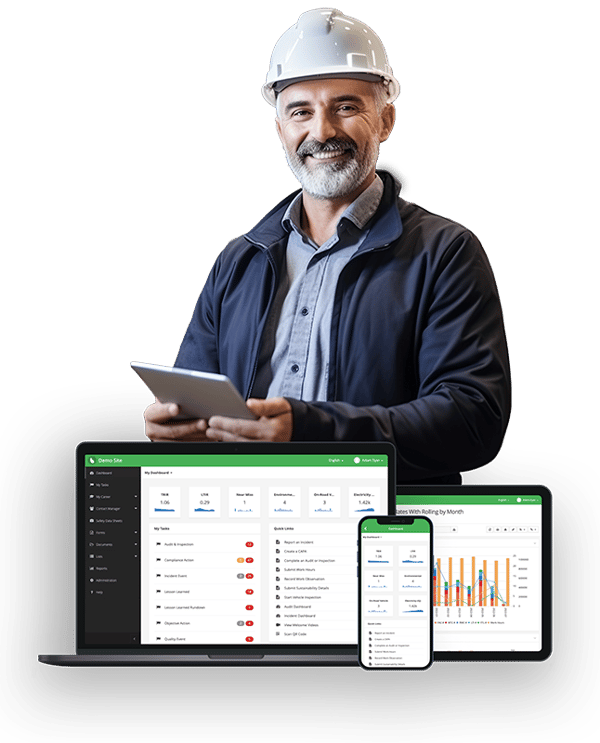
EHS Insight runs on iOS and Android, with native apps in the Apple App Store and Google Play. The full inspection, JHA, observation, permit, and incident workflows run offline, completed records sync the moment the device gets back on a network. There is no 'we were out of range so we didn't log it' gap in your record. 

Dashboards configure per role: a field supervisor sees today's active permits and open inspection findings; an HSE coordinator sees the asset rollup; a VP of HSE sees the enterprise scorecard with TRIR, PSE rates, and training compliance by business unit. Everyone works from the same underlying data. 

For offshore and remote operations with satellite connectivity, the offline-first architecture means the safety program keeps running through every connectivity gap, and the record is complete when the crew rotates out. 

The Oil & Gas Safety Metrics that Matter, and How the Platform Moves Them

Lagging indicators measure what already happened. Leading indicators tell you what's building. In oil and gas, where a single Tier 1 PSE can generate fatalities, regulatory action, and reputational damage simultaneously, the leading indicators are where the investment pays off. EHS Insight tracks both.

Lagging Indicators (Built-In Reporting)

  • TRIR, Total Recordable Incident Rate. Oil and gas extraction average consistently exceeds the all-industry benchmark.
  • DART, Days Away, Restricted, or Transferred. Directly drives workers' comp costs and workforce availability.
  • LTIR, Lost Time Incident Rate.
  • Tier 1 Process Safety Events, Loss of primary containment with defined consequences per API RP 754.
  • Tier 2 Process Safety Events, Loss of primary containment below Tier 1 threshold.
  • Fatality and serious injury rate by asset, crew, and contractor company.
  • Stop-work authority events logged and investigated per asset per month.
  • Observation and near-miss submission rate per worker, the single strongest predictor of incident rate in O&G programs.
  • Permit-to-work completion and audit rate across simultaneous operations.
  • Pre-task plan completion rate before first operation of shift.
  • Toolbox talk and safety meeting completion rate per crew.
  • Training currency by worker, crew, and asset, with days-to-expiry for critical credentials.
  • Inspection completion rate and time-to-close on open CAPAs.
  • Contractor qualification compliance rate at time of gate access.

Leading Indicators (Where the Platform Pays for Itself)

  • Stop-work authority events logged and investigated per asset per month.
  • Observation and near-miss submission rate per worker, the single strongest predictor of incident rate in O&G programs.
  • Permit-to-work completion and audit rate across simultaneous operations.
  • Pre-task plan completion rate before first operation of shift.
  • Toolbox talk and safety meeting completion rate per crew.
  • Training currency by worker, crew, and asset, with days-to-expiry for critical credentials.
  • Inspection completion rate and time-to-close on open CAPAs.
  • Contractor qualification compliance rate at time of gate access.
  • Alyeska Pipeline Logo
  • Bristol Bay
  • Ensign Logo
  • Helmerich Payne Logo
  • Modec International Logo

EHS Professionals Rank us a G2 Leader in 2026

  • EHS Software_Challenger
  • Capterra Shortlist 2026
  • Software Advice Front Runners 2026
  • Environmental,QualityandSafetyManagement_Leader_Leader-1
  • EnvironmentalHealthandSafety_BestMeetsRequirements_Enterprise_MeetsRequirements
  • EnvironmentalHealthandSafety_BestRelationship_Enterprise_Total
  • EnvironmentalHealthandSafety_BestRelationship_Mid-Market_Total
  • EnvironmentalHealthandSafety_BestResults_Mid-Market_Total
  • EnvironmentalHealthandSafety_BestSupport_Enterprise_QualityOfSupport
  • EnvironmentalHealthandSafety_BestUsability_Enterprise_Total
  • EnvironmentalHealthandSafety_BestUsability_Mid-Market_Total
  • EnvironmentalHealthandSafety_EasiestAdmin_Mid-Market_EaseOfAdmin
  • EnvironmentalHealthandSafety_EasiestSetup_Enterprise_EaseOfSetup
  • EnvironmentalHealthandSafety_EasiestSetup_Mid-Market_EaseOfSetup
  • EnvironmentalHealthandSafety_EasiestToDoBusinessWith_Mid-Market_EaseOfDoingBusinessWith
  • EnvironmentalHealthandSafety_EasiestToUse_Enterprise_EaseOfUse
  • EnvironmentalHealthandSafety_EasiestToUse_Mid-Market_EaseOfUse
  • EnvironmentalHealthandSafety_HighestUserAdoption_Adoption
  • EnvironmentalHealthandSafety_HighPerformer_Enterprise_HighPerformer
  • EnvironmentalHealthandSafety_MomentumLeader_Leader
  • EnvironmentalHealthandSafety_MostImplementable_Enterprise_Total
  • EnvironmentalHealthandSafety_UsersMostLikelyToRecommend_Mid-Market_Nps-1

Oil & Gas Safety Software FAQ 

What is oil and gas safety management software?

Oil and gas safety management software is a platform that helps upstream, midstream, and downstream operators manage HSE programs from a single system. It typically covers job hazard analyses, permit to work, inspections, incident reporting, process safety management documentation, OSHA 300 record-keeping, training and qualifications, observations and near misses, and contractor management. The goal is to replace paper, spreadsheets, and disconnected tools with one mobile-ready record of what is happening across every asset and operation. 

Does EHS Insight support OSHA 1910.119 Process Safety Management (PSM)?

Yes. EHS Insight supports the key elements of OSHA 1910.119 PSM including Process Hazard Analysis (PHA) action item tracking, Management of Change (MOC) workflows, Mechanical Integrity inspection records, Hot Work permits, Contractor safety management, Incident Investigation with root cause analysis, and Compliance Audits. The platform provides the documentation infrastructure for all 14 PSM elements. 

Does EHS Insight support API RP 754 process safety performance indicators?

Yes. EHS Insight classifies and tracks Tier 1 and Tier 2 process safety events per API RP 754, as well as the Tier 3 and Tier 4 demand indicators (near misses, unsafe conditions) that serve as leading indicators for LOC events. PSE data feeds into the analytics dashboard for trending and benchmarking. 

Can it support contractor prequalification for ISNetworld, Veriforce, and Avetta?

Yes. EHS Insight manages the documentation that feeds contractor prequalification systems including EMR records, OSHA 300 logs, training matrices, COIs, and incident history. The platform helps maintain the data quality and currency that prequalification system audits require, reducing the score impact of documentation gaps on ISNetworld, Veriforce, Avetta, and ComplyWorks profiles. 

Does it work offshore and in remote field locations without connectivity?

Yes. The full inspection, JHA, permit, observation, and incident workflows run offline on iOS and Android. Records sync automatically when the device reconnects to a network. For offshore rotations and remote pad locations where connectivity is intermittent or satellite-only, the offline-first architecture ensures the safety program keeps running and the record stays complete through every connectivity gap. 

Does it support BSEE SEMS requirements for offshore operations?

Yes. EHS Insight supports the Safety and Environmental Management System (SEMS) documentation requirements under BSEE, including the 13 SEMS elements: Hazard Analysis, Management of Change, Operating Procedures, Safe Work Practices, Training, Mechanical Integrity, Pre-Startup Review, Emergency Response, Investigation of Incidents, Auditing, Records and Documentation Management, and Stop Work Authority. 

How does EHS Insight help reduce EMR?

Experience Modification Rate is driven by the frequency and cost of workers' comp claims over a rolling three-year period, including contractor incidents that count against the operator's recordable log. EHS Insight reduces both by surfacing hazards at the observation and near-miss stage before they produce injuries, by accelerating CAPA closure on inspection findings, and by ensuring OSHA recordable classification is correct on the first entry. Lower TRIR and DART over time pulls EMR down, directly reducing premium and protecting prequalification scores that have EMR ceilings. 

How long does implementation take?

EHS Insight is built for fast implementation. Most oil and gas clients are running their core modules, incident reporting, permit to work, inspections, JHAs, training, within weeks, not months. Customer success and implementation support are included with every subscription. 

What does it cost?

Request a custom quote and the team will scope pricing to your headcount, modules, and project profile.