Chemical Industry Safety Management Software
Built for process safety. Built for PSM and RMP. Built to keep your people, your community, and your operating license safe.
The chemical industry operates under a safety and compliance burden that few other sectors match. OSHA PSM and EPA RMP govern the same covered processes from two different enforcement angles. TSCA, RCRA, EPCRA Tier II, and SARA Title III layer on additional reporting obligations that run on their own calendars. And underlying all of it is the fundamental process safety reality: a single loss of primary containment event at a chemical facility can injure workers, trigger community evacuations, generate regulatory enforcement actions, and produce litigation that runs for years.
The EHS programs that prevent those outcomes share common traits. They manage change rigorously. They investigate incidents and near misses before root causes are forgotten. They keep training and qualifications current in a workforce where process knowledge is the primary line of defense. And they maintain the compliance documentation that proves all of the above when a regulator, insurer, or community right-to-know requestor asks for it.
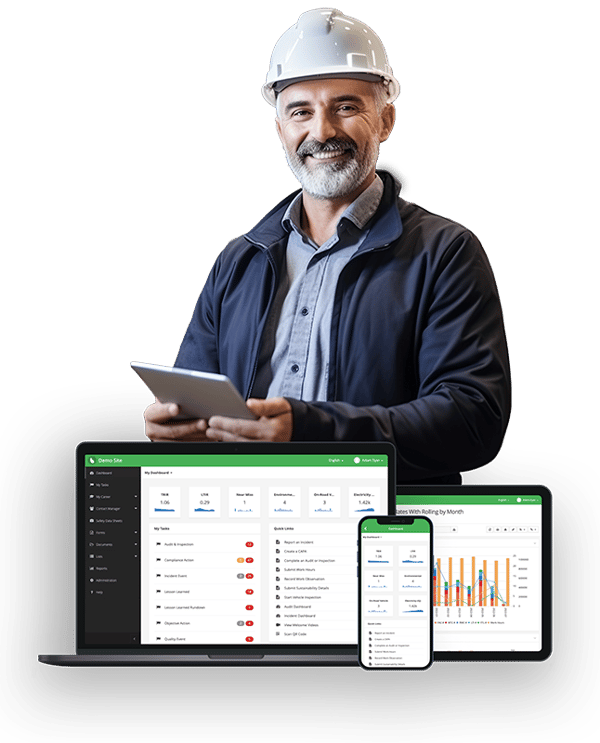
EHS Insight is built for that program. We help specialty chemical manufacturers, bulk chemical producers, formulators, and chemical distributors manage incident investigation, compliance task tracking, management of change, training qualification records, and audit documentation from a single platform. Trusted by Ampacet, BCI, ETG, Opterra, and Stephenson Group across specialty chemicals, additives, coatings, and chemical distribution.
What You’ll Find on this Page
The chemical safety problems EHS Insight is built to solve, how the platform maps to OSHA PSM, EPA RMP, TSCA, and Tier II compliance, how it works across different chemical sub-sectors, the five modules chemical industry customers use most (and why), the metrics it tracks, and links to deeper resources on each topic.
The Chemical Industry Safety Problem this Software Exists to Solve
Chemical EHS teams are not short on regulatory knowledge. They understand PSM. They know RMP. They’ve read the TSCA inventory rules and they’ve filed Tier II reports. The problem isn’t awareness of the obligations. The problem is execution at scale, managing dozens of simultaneous compliance deadlines, change control workflows, training expiration dates, and incident investigation threads across multiple processes, shifts, and sites, while keeping the documentation tight enough to survive an OSHA inspection, an EPA audit, and a community right-to-know request in the same quarter.
Most chemical facilities are still managing significant portions of that on spreadsheets, paper, and disconnected systems. The failure modes are familiar:
- A management of change review that was completed but never formally closed out, leaving an open PSM element gap when auditors arrive.
- A Tier II report filed late because the data lived in three different systems and no one owned the deadline.
- A near-miss chemical release that was logged but never investigated to root cause, and then the same failure mode recurred six months later.
- Training records that showed workers as current but reflected a course that no longer covered the process hazards they were exposed to.
- An EPA RMP update that was triggered by a process change but missed because the MOC system and the RMP calendar weren’t connected.
EHS Insight closes those gaps. One platform, configurable for your process mix, with the compliance calendar, change control, incident management, and training tracking that chemical EHS programs actually need.

Built Around the Hazards That Define Chemical Industry Risk
Chemical manufacturing presents a hazard profile driven by the properties of the substances being handled, processed, stored, and transported, not just the equipment being used to do it. Every EHS Insight capability in a chemical environment traces back to managing these hazard categories more systematically than paper and spreadsheets can.
Loss of Primary Containment and Process Safety Events
The consequence that chemical EHS programs exist to prevent. A LOC event involving a toxic, flammable, or reactive substance can produce injuries, fatalities, environmental damage, and community impact simultaneously. EHS Insight manages the PSM and RMP elements that prevent LOC events: PHA action items, MOC workflows, mechanical integrity inspection records, hot work and confined space permits, and incident investigation with root cause analysis. Tier 1 and Tier 2 process safety event classifications track the ones that do occur against API RP 754 and company-defined thresholds.
Toxic and Reactive Chemical Exposure
Acute and chronic exposure to process chemicals, solvents, corrosives, and reactive intermediates is the occupational health driver in chemical manufacturing. EHS Insight gives you a single, searchable library of safety data sheets and the ability to assign each SDS to the work areas where the chemical is used — keeping the right documentation tied to the right location and easy to retrieve in the field.
Fire, Explosion, and Reactive Hazards
Flammable liquids, oxidizers, pyrophorics, and reactive systems require permit-to-work controls that function before the hazard is activated, not after. EHS Insight manages hot work permits, process isolation verification, atmospheric monitoring records, and fire watch documentation in a single timestamped record.
Environmental Release and Regulatory Reporting
Environmental releases carry real regulatory weight, and EHS Insight gives you a place to record each release and manage the corrective and preventive actions (CAPAs) that follow — so the event and its response live in one auditable record.
Contractor and Turnaround Safety
Chemical plant turnarounds and capital projects bring high contractor density into high-hazard environments under simultaneous permit loads. EHS Insight manages contractor prequalification, site-specific orientation records, permit-to-work approvals across simultaneous operations, and contractor incident data that rolls into the facility’s total recordable log.

OSHA PSM, EPA RMP, TSCA, and Multi-Agency Compliance Without the Paperwork Drag
Chemical companies face a multi-agency compliance calendar that is more complex than almost any other industrial sector. EHS Insight ships with templates, workflows, and record-keeping built for the frameworks that drive most chemical EHS program decisions:
- OSHA 1910.119, Process Safety Management of Highly Hazardous Chemicals. PHA action tracking, MOC documentation, mechanical integrity inspection records, hot work permits, contractor safety management, incident investigation, and compliance audit records for all 14 PSM elements.
- EPA 40 CFR Part 68, Risk Management Program (RMP). Program 2 and Program 3 facilities maintain prevention program documentation, emergency response plan records, and five-year accident history data within the same system used for day-to-day EHS management. RMP submission update triggers flag when a covered process change requires an amended filing.
- TSCA, Toxic Substances Control Act. Chemical inventory tracking, Section 8(e) substantial risk reporting workflows, and compliance task management for CDR (Chemical Data Reporting) cycle deadlines.
- EPCRA / SARA Title III, Tier II Emergency and Hazardous Chemical Inventory reporting. Annual reporting deadlines tracked as compliance tasks with owner assignment and escalation.
- RCRA, Resource Conservation and Recovery Act. Hazardous waste generation, storage, and disposal documentation. Generator status compliance tasks (LQG, SQG, VSQG), manifest records, and inspection logs for satellite accumulation and storage areas.
- OSHA 1910.1200, Hazard Communication. SDS management, chemical inventory by work area, PPE assignment by substance, and employee right-to-know training records.
- DOT 49 CFR, Hazardous materials shipping compliance records, training documentation for HazMat employees, and incident reporting for transportation releases.
OSHA 300, 300A, and 301 forms are built in. Record an incident, classify it correctly, and the recordable log updates automatically. ITA electronic submission is supported directly from the same record.
How it Works Across Specialty Chemical, Bulk Chemical, and Formulation Operations
Chemical manufacturing is not a single operating model. A specialty chemical producer running covered PSM processes has different daily EHS touchpoints than a formulation house managing Hazcom and training compliance, or a chemical distributor managing DOT, Tier II, and contractor safety at terminal locations. EHS Insight is configurable for each.
|
Specialty Chemical / PSM-Covered |
Formulation & Blending |
Chemical Distribution & Terminals |
|
PHA action item tracking, MOC workflows, mechanical integrity inspection records, and PSM compliance audit documentation. |
Hazcom training records, SDS management by work area, PPE assignment by chemical, and near-miss reporting for blending and transfer operations. |
Tier II inventory tracking, DOT HazMat employee training records, terminal inspection logs, and contractor safety management. |
|
EPA RMP prevention program documentation and five-year accident history records in the same system as daily EHS operations. |
Incident reporting for chemical exposures, spills, and releases with RQ-threshold classification and regulatory notification tracking. |
RCRA manifest records, satellite accumulation inspection logs, and LQG/SQG generator status compliance tasks. |
|
Enterprise rollup across facilities for VP of EHS and board-level PSE rate and TRIR reporting. |
Mobile-first for shift supervisors and operators who need to log observations and incidents from the production floor. |
Emergency response documentation and LEPC notification records for RQ releases tied to the incident record. |
What EHS Insight Actually Does in Chemical Industry Operations

Incident Management
Chemical releases, exposures, and near misses carry multi-agency notification obligations and serious injury potential. Fast, accurate capture is non-negotiable.
Audit Management
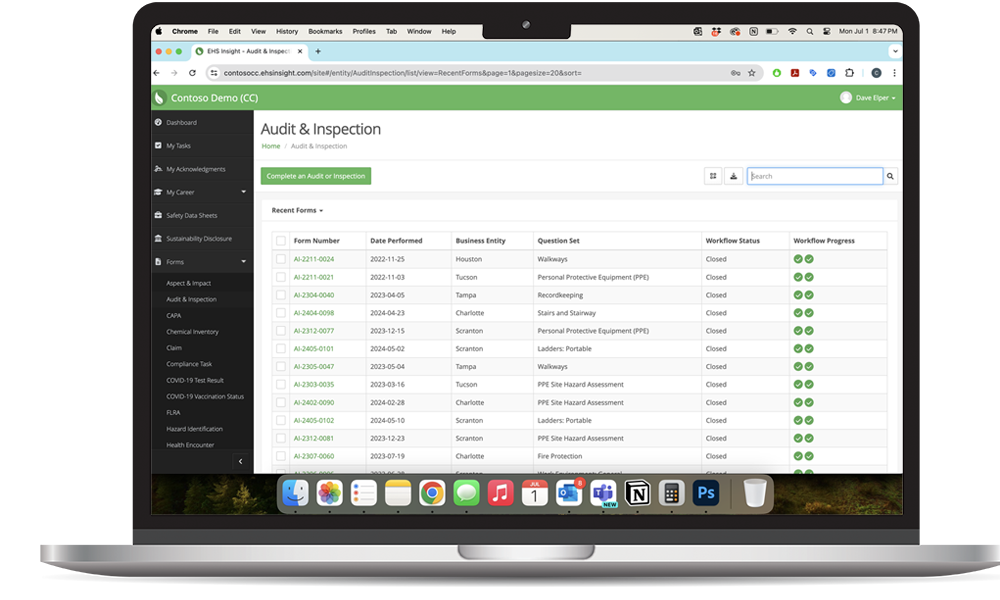
PSM compliance audits, EPA RMP reviews, internal process safety assessments, and Hazcom inspections all require a consistent, retrievable audit record.
Compliance Tasks Management
Multi-agency reporting calendars, OSHA PSM, EPA RMP, TSCA CDR, Tier II, TRI, RCRA, run on independent deadlines. Centralizing them prevents the missed filing that triggers enforcement.
Management of Change (MoC)
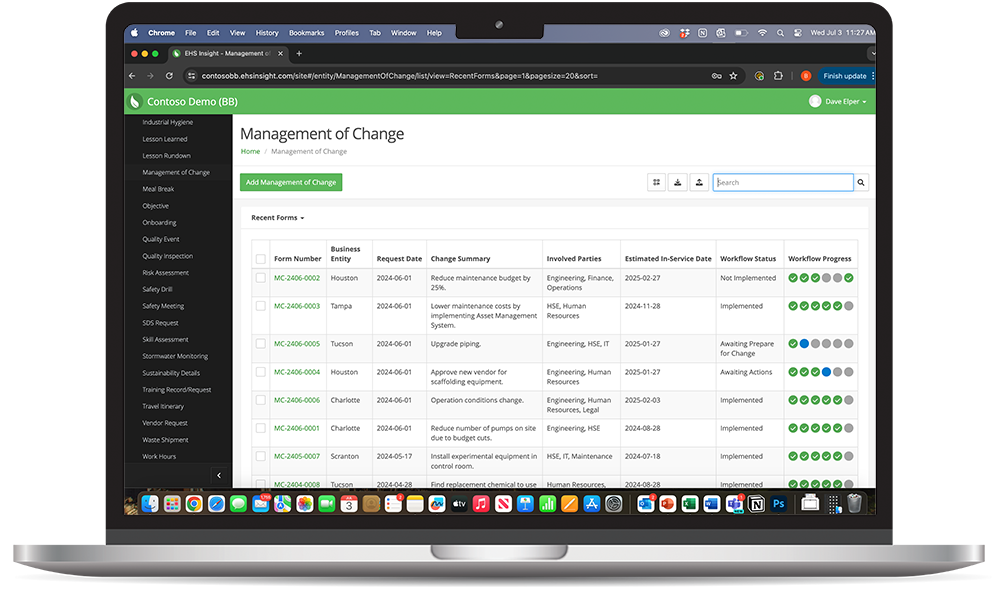
Process changes in chemical facilities can alter PSM covered process parameters, trigger RMP amendment requirements, and create new worker exposure hazards. MOC is the control that keeps all of that documented and closed out.
Training Management
Process knowledge is the primary line of defense in chemical manufacturing. Chemical customers use this module to keep qualifications current, prove competency for PSM and RMP purposes, and ensure training gaps don’t outlast a shift change.
SDS Dashboard & Chemical Management
EHS Insight's SDS Dashboard simplifies HazCom compliance by centralizing all safety data sheets in one searchable location, accessible online or offline. Bulk uploads, automatic SDS updates, QR code access, and OSHA-compliant label generation help organizations manage chemicals more efficiently while maintaining audit readiness. An optional managed service handles SDS sourcing, updates, and version control, reducing the administrative burden on your team.
Permit to Work
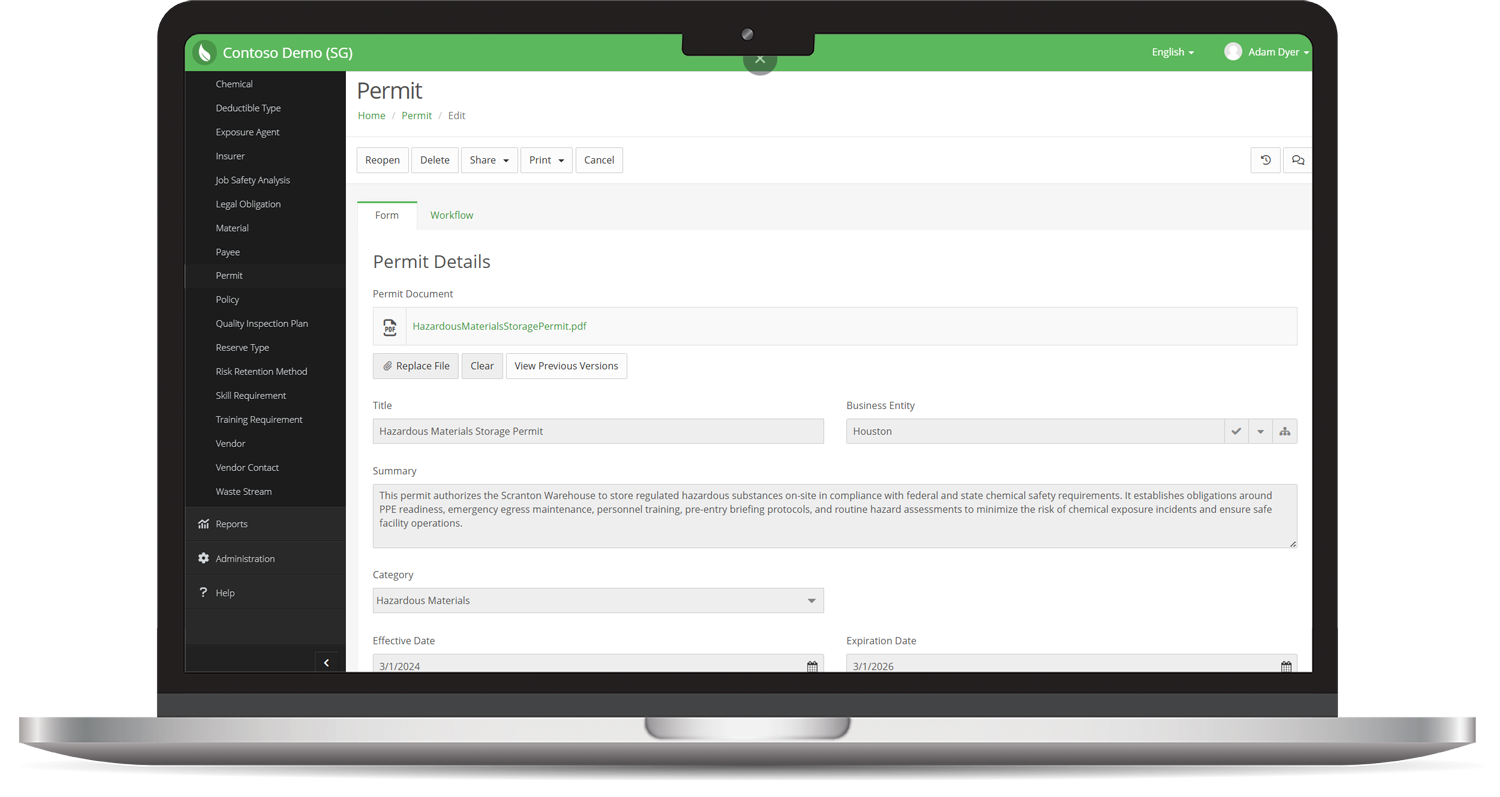
Hot work, confined space entry, energized electrical isolation (LOTO), chemical line breaking, and simultaneous operations, issue, approve, and close out permits with the right signatories, atmospheric monitoring records, isolation verification, and attached JHAs. The work doesn’t start until every required condition is confirmed. Every permit is timestamped and attached to the location and crew where the work was performed.
Observations & Near Misses
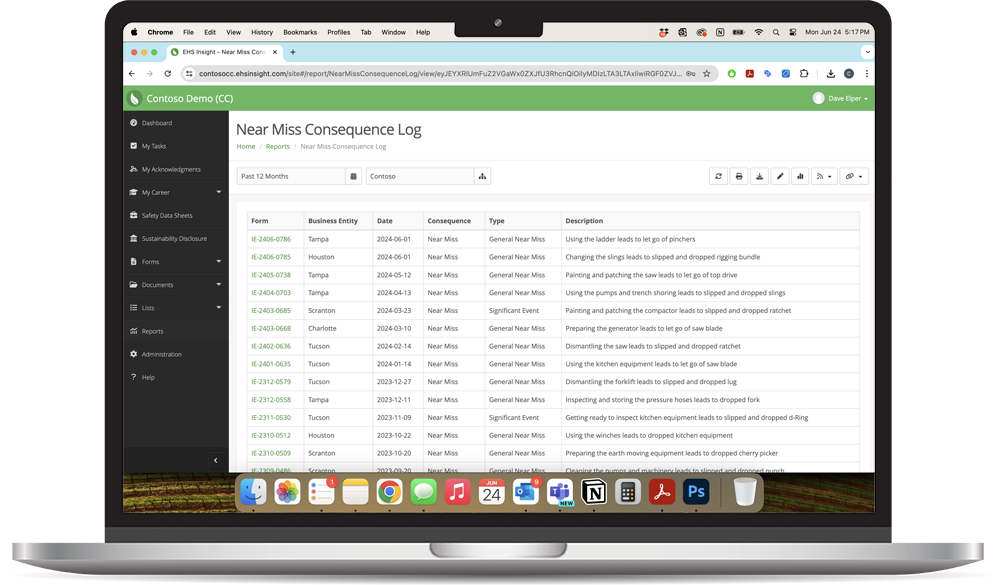
The leading indicator with the highest return on investment in any chemical safety program. EHS Insight makes a near-miss or unsafe condition submission a 30-second task from any device on the plant floor. Observation data rolls into dashboards that surface patterns by process area, shift, and hazard category, so the safety team sees what’s building before it produces a recordable incident or a process safety event.
Chemical releases, exposures, and near misses carry multi-agency notification obligations and serious injury potential. Fast, accurate capture is non-negotiable.
PSM compliance audits, EPA RMP reviews, internal process safety assessments, and Hazcom inspections all require a consistent, retrievable audit record.
Multi-agency reporting calendars, OSHA PSM, EPA RMP, TSCA CDR, Tier II, TRI, RCRA, run on independent deadlines. Centralizing them prevents the missed filing that triggers enforcement.
Process changes in chemical facilities can alter PSM covered process parameters, trigger RMP amendment requirements, and create new worker exposure hazards. MOC is the control that keeps all of that documented and closed out.
Process knowledge is the primary line of defense in chemical manufacturing. Chemical customers use this module to keep qualifications current, prove competency for PSM and RMP purposes, and ensure training gaps don’t outlast a shift change.
EHS Insight's SDS Dashboard simplifies HazCom compliance by centralizing all safety data sheets in one searchable location, accessible online or offline. Bulk uploads, automatic SDS updates, QR code access, and OSHA-compliant label generation help organizations manage chemicals more efficiently while maintaining audit readiness. An optional managed service handles SDS sourcing, updates, and version control, reducing the administrative burden on your team.
Hot work, confined space entry, energized electrical isolation (LOTO), chemical line breaking, and simultaneous operations, issue, approve, and close out permits with the right signatories, atmospheric monitoring records, isolation verification, and attached JHAs. The work doesn’t start until every required condition is confirmed. Every permit is timestamped and attached to the location and crew where the work was performed.
The leading indicator with the highest return on investment in any chemical safety program. EHS Insight makes a near-miss or unsafe condition submission a 30-second task from any device on the plant floor. Observation data rolls into dashboards that surface patterns by process area, shift, and hazard category, so the safety team sees what’s building before it produces a recordable incident or a process safety event.
Mobile-Ready & Offline. Because Not Every Facility Has Reliable WiFi.
EHS Insight runs on iOS and Android, with native apps in the Apple App Store and Google Play. The full inspection, JHA, observation, permit, incident, and MOC initiation workflows run offline, completed records sync the moment the device reconnects. Chemical facilities with large footprints, outdoor process areas, and tank farm locations know that wifi coverage is inconsistent, and the safety program has to function everywhere work is happening.
Dashboards configure per role: a shift supervisor sees active permits and open inspection findings for their area; a process safety engineer sees PHA action items and open MOC records; a VP of EHS sees the enterprise compliance calendar, TRIR trend, and training compliance rate by facility. Everyone works from the same underlying data.
The Chemical Safety Metrics that Matter, and How the Platform Moves Them
Lagging indicators confirm what happened. Leading indicators tell you what’s accumulating. In chemical manufacturing, where the gap between a near miss and a catastrophic release can be measured in millimeters of pipe wall or one missed MOC review, the leading indicators are where the program investment pays off.
Lagging Indicators (Built-In Reporting)
- TRIR, Total Recordable Incident Rate. Chemical sector benchmarks vary by NAICS; EHS Insight tracks your rate against your specific subsector average.
- DART, Days Away, Restricted, or Transferred.
- LTIR, Lost Time Incident Rate.
- Process Safety Event rate, Tier 1 and Tier 2 classifications per API RP 754 or company-defined thresholds.
- Environmental release incidents by substance
- Workers’ comp claim frequency and average cost per claim.
- MOC cycle time, average days from initiation to closure. Long cycle times indicate process change backlog; unclosed MOCs are open PSM compliance gaps.
- PSM compliance audit finding closure rate and time-to-close. Open audit findings past their due date are the most common OSHA PSM citation pattern.
- Compliance task on-time completion rate by agency and obligation type.
- Training currency by process area, shift, and qualification type, especially PSM operator training and HAZWOPER certification levels.
- Observation and near-miss submission rate per worker per month, the leading indicator most predictive of incident rate reduction.
- Inspection completion rate and average CAPA closure time for process safety-critical equipment.
- Permit-to-work compliance rate and simultaneous operations conflicts flagged before approval.
Leading Indicators (Where the Platform Pays for Itself)
- MOC cycle time, average days from initiation to closure. Long cycle times indicate process change backlog; unclosed MOCs are open PSM compliance gaps.
- PSM compliance audit finding closure rate and time-to-close. Open audit findings past their due date are the most common OSHA PSM citation pattern.
- Compliance task on-time completion rate by agency and obligation type.
- Training currency by process area, shift, and qualification type, especially PSM operator training and HAZWOPER certification levels.
- Observation and near-miss submission rate per worker per month, the leading indicator most predictive of incident rate reduction.
- Inspection completion rate and average CAPA closure time for process safety-critical equipment.
- Permit-to-work compliance rate and simultaneous operations conflicts flagged before approval.
What Chemical Customers Say:
This is the 2nd employer I've initiated EHS Insight with. I love the software, but I especially love the team that makes this program possible. We're so happy to have replaced our old HSE management system with EHS Insight!"
“It is the most user-friendly system ever and makes life easy for EHS professionals.”
“Our organization has had a very good experience with the platform and the support from EHS Insight. It has changed and strengthened our safety culture.”
Chemical Safety Software FAQ
What is chemical safety management software?
Chemical industry safety management software is a platform that helps chemical manufacturers, specialty chemical producers, formulators, and distributors manage EHS programs from a single system. It typically covers incident reporting and investigation, PSM and RMP documentation, management of change workflows, compliance task tracking, training and qualification records, audits and inspections, observations and near misses, and permit to work. The goal is to replace paper, spreadsheets, and disconnected tools with one auditable record across every process area and facility.
What is chemical industry safety management software?
Yes. EHS Insight supports all 14 PSM elements, with workflows specifically built for Process Hazard Analysis action item tracking, Management of Change documentation and closure, Mechanical Integrity inspection records, Hot Work permits, Contractor safety management, Incident Investigation with root cause analysis, and the three-year PSM Compliance Audit cycle. The audit trail for each element is maintained continuously, not reconstructed before an inspection.
Does it support EPA RMP compliance?
Yes. EHS Insight supports EPA 40 CFR Part 68 RMP program documentation including prevention program records for Program 2 and Program 3 facilities, five-year accident history maintenance from the incident management module, emergency response plan documentation, and compliance task tracking for RMP resubmission triggers when covered process changes occur. The five-year accident history required for RMP submissions is maintained automatically as incidents are recorded and classified.
How does EHS Insight handle Management of Change for chemical processes?
The MOC module initiates, routes, reviews, approves, and formally closes change requests within the platform. Each record attaches the hazard review, affected documents, required training assignments, implementation verification, and sign-off from every required reviewer. Open MOC items are tracked on the compliance dashboard. When a process change triggers a PSM or RMP documentation update requirement, that obligation is created as a linked compliance task and assigned to an owner with a due date.
Can it manage multi-agency compliance reporting deadlines like Tier II and TRI?
Yes. EHS Insight’s Compliance Task module tracks every recurring regulatory obligation, Tier II (March 1), TRI Form R (July 1), TSCA CDR cycle, RCRA biennial reports, PSM three-year audits, RMP five-year updates, and state permit reporting, in a single dashboard with owner assignment, due dates, escalation paths, and supporting documentation. Each obligation has an audit trail that shows who completed it, when, and with what supporting data.
Does it track HAZWOPER and PSM operator training currency?
Yes. EHS Insight tracks every required qualification including HAZWOPER 40-hour, 24-hour, and 8-hour refresher certifications, PSM operator initial and refresher training by process unit, confined space entry authorization, hot work authorization, emergency response team qualifications, and any other facility-defined credential. Expiration alerts notify supervisors before credentials lapse. When an MOC closes out a process change that requires re-training, the training requirement is assigned within the same system and tracked to completion.
Does it work across multiple chemical facilities?
How long does implementation take?
EHS Insight is built for fast implementation. Most chemical industry clients are running their core modules, incident management, compliance task tracking, MOC, training, and audit management, within weeks, not months. Customer success and implementation support are included with every subscription.
What does it cost?
Request a custom quote and the team will scope pricing to your headcount, modules, and project profile.