EBOOK

10 marketing metrics that directly correlate with ROI

Lorem ipsum dolor sit amet, consectetur adipiscing elit, sed do eiusmod tempor incididunt ut labore et dolore magna aliqua. Ut enim ad minim veniam, quis nostrud exercitation ullamco.
Logistics & Supply Chain Safety Management Software

Built for warehouses, distribution centers, and fleets. Built for DOT, FMCSA, and OSHA. Built so your operation runs safely every shift.

Logistics and supply chain is one of the most physically demanding and compliance-intensive operating environments in any economy. Warehouse workers face the highest rates of musculoskeletal injuries, struck-by incidents, and forklift-related fatalities in any industry outside of construction. Fleet operations carry DOT and FMCSA compliance obligations that run on their own inspection, training, and recordkeeping calendars. Distribution centers managing hazmat shipments add IATA, IMDG, and 49 CFR HazMat employee training requirements on top of OSHA 1910. And the workforce turnover rates in logistics — among the highest of any sector — mean training and qualification management isn’t a one-time event. It’s a continuous operational requirement.

EHS Insight is built for that environment. We help 3PLs, freight carriers, terminal operators, distribution center networks, and supply chain organizations standardize warehouse inspections across every shift, report incidents from the dock floor in minutes, track DOT and FMCSA compliance obligations, deliver and document safety training for high-turnover workforces (including SCORM-compatible content), and maintain SDS records for hazmat and chemical products handled in every facility. One platform, mobile-first, offline-capable, built around the pace of logistics operations. Trusted by Associated Terminals, Crowley Logistics, Enstructure, Kane, and Cohen Recycling.

What You’ll Find on this Page

The logistics safety problems EHS Insight is built to solve, how the platform maps to DOT, FMCSA, OSHA, and multi-agency compliance, how it works across warehouse, fleet, and terminal environments, the five modules logistics customers use most (and why), the metrics it tracks, and links to deeper resources on each topic.

Unlock Your Free Access Now
Get My Custom Quote

The Logistics & Supply Chain Safety Problem this Software Exists to Solve

Safety leaders in logistics are not short on hazard awareness. They know the dock is dangerous. They know forklift near misses are undercounted. They know that new hires on the warehouse floor are statistically more likely to be injured in their first 90 days than at any other point in their tenure. The problem isn’t knowing where the risk is. The problem is managing it consistently across multiple shifts, multiple sites, a high-turnover workforce, a mobile fleet that operates outside the facility perimeter, and a compliance calendar that spans DOT, FMCSA, OSHA, and potentially IATA or IMDG, simultaneously, every day.

Most logistics organizations are still managing critical portions of that on paper, spreadsheets, and manual processes that break down when volumes peak and supervisors are stretched. The familiar failure modes:

  • Pre-shift forklift inspections completed on paper, filed in a binder, and never reviewed until a near miss or fatality forces a look back.
  • Incident reports written on a clipboard, photographed, and emailed to a safety manager who re-enters them into a spreadsheet. The root cause analysis never happens because the investigation lag killed momentum.
  • DOT and FMCSA compliance deadlines managed in someone’s calendar or a shared spreadsheet. A missed CDL medical certification renewal or ELD audit creates regulatory exposure that takes months to resolve.
  • New hire training documented on sign-in sheets that prove attendance but not comprehension. When an injury occurs, the training record doesn’t hold up.
  • Hazmat SDS records that exist somewhere, a binder, a shared drive, a carrier’s portal, but aren’t accessible from the dock floor at 2 AM when an emergency responder needs them.
  • A VP of HSE who described it perfectly: “we had over 40 paper-based processes that needed to become electronic workflows.” That’s the starting point for most logistics EHS programs when they find EHS Insight.

EHS Insight closes those gaps. One platform, mobile-first, with the inspection, incident, training, compliance, and SDS workflows that logistics safety programs actually run on.

The Construction Safety Problem this Software Exists to Solve

Built Around the Hazards That Define Logistics & Supply Chain Risk

The hazard profile in logistics spans two fundamentally different operating environments: fixed facilities (warehouses, DCs, terminals, cross-docks) and mobile operations (fleets, last-mile delivery, intermodal transfer), each with distinct risk drivers and distinct regulatory frameworks. EHS Insight is built to manage both from a single system.

Forklift & Powered Industrial Truck Operations

Forklift incidents are the leading cause of serious injury and fatality in warehouse and distribution environments. OSHA cites powered industrial truck violations as a perennial top-10 citation, and the standard requires daily pre-use inspections, operator evaluation every three years, and documented training for every operator. EHS Insight standardizes pre-shift forklift inspection checklists across every shift and site, tracks operator certification and recertification dates, and triggers corrective actions automatically when an inspection finding identifies a deficiency. The deficiency record doesn’t disappear when the next shift starts.

Struck-By, Caught-In, and Loading Dock Hazards

The pedestrian-vehicle interface in a busy distribution center or loading dock environment is where the majority of serious injuries occur. Observation programs that capture unsafe conditions — blocked sight lines, missing dock plates, unsecured loads, missing pedestrian barriers, before they result in injuries are the primary leading-indicator tool in high-activity warehouse environments. EHS Insight makes a mobile observation a 30-second submission from any worker on any shift. Patterns surface in dashboards before they become OSHA recordables.

Musculoskeletal Injuries & Ergonomics

Warehouse operations consistently produce the highest rates of sprains, strains, and repetitive motion injuries in any indoor work environment. Ergonomic risk assessments by workstation, task type, and shift pattern, documented in EHS Insight and linked to corrective actions, give safety teams the documented baseline required to demonstrate a proactive ergonomics program when OSHA or workers’ comp reviewers ask.

Fleet Safety, Driver Hours of Service & DOT Compliance

For logistics organizations operating commercial motor vehicles, DOT and FMCSA compliance runs on an independent calendar from the warehouse safety program, but it lives in the same risk register. Driver qualification file currency, hours of service recordkeeping, vehicle inspection reports (DVIRs), and hazmat endorsement tracking feed into EHS Insight’s compliance task register so nothing expires silently. Vehicle incident reporting captures the first notice of loss data that both the safety investigation and the insurance carrier need.

Hazardous Materials Handling & SDS Access

Distribution centers handling chemical products, cleaning agents, fuels, batteries, or industrial gases need SDS records accessible at the point of handling, not in a binder in the safety office. HazMat employee training under 49 CFR Part 172 requires documentation of function-specific training and recertification every three years. EHS Insight’s SDS Dashboard and Training Management module handle both: centralized SDS access by location, mobile QR code lookup, and training expiration tracking with supervisor alerts before the recertification date.

Construction Compliance Without the Paperwork Drag

DOT, FMCSA, OSHA, and Multi-Agency Compliance Without the Paperwork Drag

Logistics and supply chain organizations often sit at the intersection of more regulatory frameworks than their safety team size should reasonably manage. EHS Insight ships with workflows, checklists, and compliance task tracking built for the frameworks that drive most logistics EHS program decisions:

  • OSHA 29 CFR 1910: General Industry. Powered industrial trucks (1910.178), walking-working surfaces (1910.22–23), hazard communication (1910.1200), fire protection, lockout/tagout, emergency action plans, and PPE standards for warehouse and terminal operations.
  • DOT 49 CFR Parts 382/391/395: FMCSA Commercial Motor Vehicle. Driver qualification file currency, CDL and medical certification tracking, hours of service compliance records, drug and alcohol testing program documentation, and electronic logging device (ELD) audit trail support.
  • DOT 49 CFR Part 172: HazMat Employee Training. Function-specific training documentation and three-year recertification tracking for employees involved in offering, accepting, or transporting hazardous materials.
  • OSHA 29 CFR 1910.119 / EPA RMP: Process Safety Management and Risk Management Program. For terminal and distribution operations handling PSM-covered quantities of hazardous chemicals.
  • IATA / IMDG / 49 CFR Part 171–180: Air and maritime hazmat shipping documentation, packaging certification records, and emergency response information management for multi-modal logistics operations.
  • ISO 45001: Occupational Health and Safety Management Systems. Audit workflows, management review records, corrective action tracking, and continual improvement documentation for logistics organizations pursuing or maintaining ISO 45001 certification.

OSHA 300, 300A, and 301 forms are built in. Record an incident, classify it correctly, and the recordable log updates automatically. ITA electronic submission is supported from the same record.

How it Works Across Warehouse, Fleet, and Terminal Operations

The safety risk profile is different at a fulfillment center, a freight terminal, a last-mile delivery operation, and a hazmat distribution facility. EHS Insight is configurable for each — from a single enterprise account that rolls up performance across the entire network.

Warehouse & Distribution Centers

Fleet & Transportation

Terminals & Port Operations

Pre-shift forklift and equipment inspections, dock safety audits, ergonomic risk assessments, and near-miss reporting from any device on any shift.

Driver qualification file tracking, DVIR documentation, hours of service compliance tasks, vehicle incident reporting, and DOT drug/alcohol program records.

Vessel and vehicle inspection records, hazmat handling documentation, contractor prequalification, simultaneous operations permits, and environmental release reporting.

OSHA 300 incident recordkeeping, new hire and annual refresher training with SCORM content integration, and compliance task tracking for recurring OSHA obligations.

HazMat employee training records, 49 CFR recertification tracking, FMCSA compliance calendar, and post-accident investigation workflows.

SDS records accessible by location and product, QR-code SDS lookup for dock workers, and SPCC/environmental compliance task management.

Mobile-first, offline-capable for shift supervisors running audits in areas without reliable WiFi coverage.

Fleet incident first notice of loss capture with photo, GPS location, and auto-routing to the right investigation and insurance workflow.

Enterprise rollup for VP of HSE: TRIR, inspection completion rate, training currency, and open CAPA aging across the entire network.

What EHS Insight Actually Does in Logistics & Supply Chain Operations 

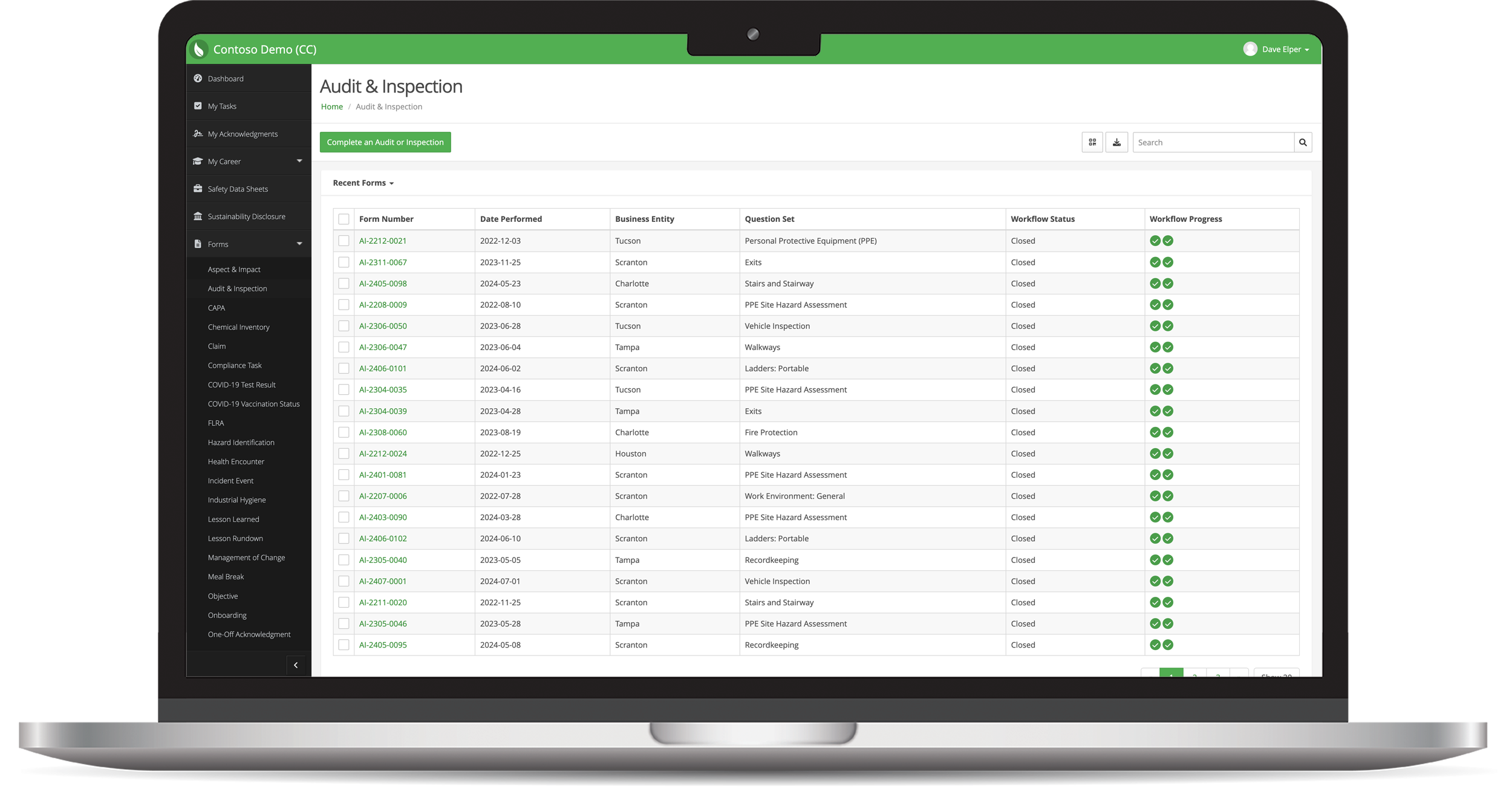
Audit & Inspection Management
audit-management-module

Warehouses, DCs, and terminals run daily equipment inspections, dock audits, and facility walk-throughs. Logistics has more recurring inspection touchpoints per shift than almost any other sector.

Incident & Event Management

incident-Template-(1)

High-activity facilities with forklift traffic, loading operations, and a high-turnover workforce generate incident volume that paper processes can’t absorb. Fast, accurate capture from the floor is the primary need.

Compliance Task Management

compliance-task-(1)

DOT, FMCSA, OSHA, and HazMat compliance obligations run on independent calendars. Centralizing them prevents the missed CDL renewal or overdue inspection that creates regulatory exposure.

Training Management

trainingmanagement-Template-(1)

High workforce turnover means onboarding training never stops. Logistics customers use SCORM-integrated training to deliver consistent role-based content and document completion for OSHA and DOT purposes.

SDS Dashboard

sds-Template-(1)

Warehouses and terminals handling chemical products, fuels, cleaning agents, and hazmat shipments need SDS records accessible at the point of handling — on any device, offline, with QR code lookup.
audit-management-module

Warehouses, DCs, and terminals run daily equipment inspections, dock audits, and facility walk-throughs. Logistics has more recurring inspection touchpoints per shift than almost any other sector.

incident-Template-(1)

High-activity facilities with forklift traffic, loading operations, and a high-turnover workforce generate incident volume that paper processes can’t absorb. Fast, accurate capture from the floor is the primary need.

compliance-task-(1)

DOT, FMCSA, OSHA, and HazMat compliance obligations run on independent calendars. Centralizing them prevents the missed CDL renewal or overdue inspection that creates regulatory exposure.

trainingmanagement-Template-(1)

High workforce turnover means onboarding training never stops. Logistics customers use SCORM-integrated training to deliver consistent role-based content and document completion for OSHA and DOT purposes.

sds-Template-(1)

Warehouses and terminals handling chemical products, fuels, cleaning agents, and hazmat shipments need SDS records accessible at the point of handling — on any device, offline, with QR code lookup.

Mobile-Ready & Offline. Because Your Operation Never Stops. 

EHS Insight runs on iOS and Android, with native apps in the Apple App Store and Google Play. The full inspection, observation, incident, permit, training, and SDS access workflows run offline, completed records sync the moment the device reconnects. Distribution centers with large footprints, loading docks in cellular dead zones, and fleet operations where drivers are between cellular coverage areas all need a safety platform that functions without waiting for a network connection.

Dashboards configure per role: a shift supervisor sees today’s inspection completion status and open safety findings for their area; a site safety manager sees the facility rollup; a VP of HSE sees the enterprise scorecard with TRIR, training compliance rate, inspection completion, and open CAPAs across the entire network. Everyone works from the same underlying data.

The Logistics Safety Metrics that Matter and How the Platform Moves Them

In logistics, the lagging indicators confirm what already happened. The leading indicators, especially in high-turnover, high-activity environments, are where the safety investment pays off before an injury occurs.

Lagging Indicators (Built-In Reporting)

  • TRIR: Total Recordable Incident Rate. Warehousing and storage consistently post rates above the all-industry average. EHS Insight benchmarks against NAICS-specific rates.
  • DART: Days Away, Restricted, or Transferred. Directly drives workers’ comp costs in a workforce where sprains, strains, and forklift incidents are the primary drivers.
  • LTIR: Lost Time Incident Rate.
  • Vehicle incident rate: by asset, driver, route, and facility for fleet operations.
  • Workers’ comp claim frequency and average cost per claim.

Leading Indicators (Where the Platform Pays for Itself)

  • Inspection completion rate by shift, site, and equipment type, especially pre-shift forklift inspection compliance, which is the single most audited OSHA metric in warehouse environments.
  • Near-miss and observation submission rate per worker per month.
  • New hire training completion rate in first 30 days, the highest-risk period for any logistics workforce.
  • Training currency by role, credential type, and facility, especially forklift operator and HazMat employee recertification status.
  • Compliance task on-time completion rate across DOT, FMCSA, and OSHA obligations.
  • CAPA closure rate and average time-to-close on inspection findings.
  • Contractor qualification compliance rate at time of facility access.
  • Associated Terminals Logo
  • Cohen Recycling
  • Crowley Logistics
  • Enstructure Logo
  • Kane Logo

What Our Customers Say:

"With three years of utilization within our organization, we have been able to move over 40 paper-based processes into electronic workflows, allowing for more streamlined and efficient safety processes."

“It is the most user-friendly system ever and makes life easy for EHS professionals.”

"EHS Insight does everything that you need it to for a lot less than competitors. Additionally, it is highly configurable to have the modules you need/want and none you don't. On top of all of that they are continuously improving based on customer feedback and the end customer isn't charged every time this happens. Also, their customer service is very responsive and excellent."

Logistics & Supply Chain Safety Software FAQ

What is logistics and supply chain safety management software?

Logistics and supply chain safety management software is a platform that helps warehouse operators, freight carriers, terminal operators, 3PLs, and distribution networks manage EHS programs from a single system. It typically covers mobile equipment and facility inspections, incident and near-miss reporting, DOT and FMCSA compliance task tracking, safety training with SCORM content support, SDS record management for hazmat and chemical products, observations, corrective actions, and regulatory recordkeeping. The goal is to replace paper-based inspection logs, spreadsheet tracking, and disconnected tools with one auditable system that functions across every shift, site, and fleet.

Does EHS Insight support DOT and FMCSA compliance for fleet operations?

Yes. EHS Insight’s Compliance Task module manages recurring DOT and FMCSA obligations including driver qualification file review cycles, CDL and medical certification renewal tracking, drug and alcohol testing program deadlines, ELD audit period records, and HazMat employee training recertification under 49 CFR Part 172. Vehicle incident reporting captures first notice of loss data in the same workflow that feeds the safety investigation and regulatory report.

Does it support SCORM-compatible training content?

Yes. EHS Insight’s Training Management module supports SCORM and AICC content delivery, enabling logistics organizations to deploy existing e-learning libraries from Marcom, Vector Solutions, or other third-party content providers through the same system used for training assignment, completion tracking, credential expiration management, and training history recordkeeping. Role-based assignments deploy automatically when a worker is onboarded, and completion records are maintained for OSHA and DOT compliance purposes.

Does it manage SDS records for warehouses handling hazmat products?

Yes. EHS Insight’s SDS Dashboard centralizes safety data sheets across every facility, accessible from any device online or offline. Bulk upload manages large product inventories. QR codes on containers and storage locations link directly to the SDS record — the right emergency response and handling information at the point of exposure, without a call to the safety office. The optional SDS Managed Service handles SDS sourcing, version control, and ongoing updates for organizations that want that function managed externally.

How does it handle high-turnover workforce training in logistics?

EHS Insight automates training assignment based on job role, so when a new hire is entered into the system with a warehouse associate, forklift operator, or driver role, the required training curriculum deploys automatically. SCORM content delivers consistent onboarding training at scale. Completion tracking and assessment scoring document competency, not just attendance. Expiration alerts notify supervisors before credentials lapse. Training history records survive workforce turnover — the record stays even when the worker doesn’t.

Does it work across multiple distribution centers and fleet locations?

Yes. Enterprise accounts configure EHS Insight to roll up safety and compliance performance across sites, regions, and business units. Each facility and fleet maintains its own inspection, incident, and compliance records while the enterprise EHS team sees the consolidated dashboard: TRIR by site, inspection completion rate by facility, training currency by location, open CAPA aging, and compliance task on-time rate across the network.

How does the inspection module handle pre-shift forklift checks?

The Audit & Inspection Management module deploys configurable pre-shift checklists on any mobile device. The inspector opens the forklift inspection checklist, works through each item, photographs any deficiency, and submits. Deficiencies trigger a corrective action automatically with an assigned owner and due date. If the forklift is flagged as out of service, the record documents that decision with timestamp and evidence. The inspection history for every piece of powered industrial truck equipment is searchable and retrievable for OSHA compliance purposes.

How long does implementation take?

EHS Insight is built for fast implementation. Most logistics clients are running their core modules — inspection management, incident reporting, compliance task tracking, training, and SDS — within weeks, not months. Customer success and implementation support are included with every subscription.

What does it cost?

Request a custom quote and the team will scope pricing to your headcount, site count, fleet size, and module requirements.