Transportation & Logistics Safety Management Software

Built for trucking, rail, and fleet operations. Built for FMCSA and DOT. Built to get your drivers home safely

Transportation is consistently one of the most dangerous industries in the United States by fatality count. Motor vehicle crashes are the leading cause of occupational death nationally, and commercial motor vehicle (CMV) operators face that risk every mile of every shift. FMCSA data shows that large truck and bus crashes kill over 4,000 people annually, and for every fatality, dozens more serious injuries occur. The compliance frameworks that govern CMV operations, FMCSA Parts 382, 391, 392, 395, and 396, exist to prevent those crashes, but only when the underlying data is accurate, current, and accessible to the people making operational safety decisions.

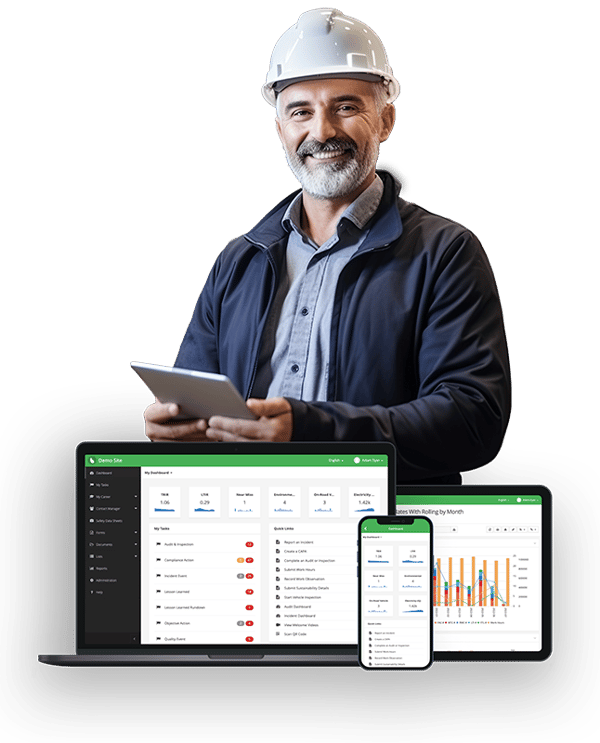
Most transportation safety programs are managing that data across a patchwork of systems: paper DVIRs, spreadsheet-tracked driver qualification files, email reminders for CDL renewals, and post-incident reports that get filed but never investigated to root cause. EHS Insight replaces that patchwork with one mobile-first platform built for the pace of transportation operations: vehicle and facility inspections from any device, driver behavior observations captured in the field, incident reporting and investigation from the roadside or the yard, compliance task tracking across FMCSA, DOT, and FRA calendars, and training records that prove competency, not just attendance.

What You’ll Find on this Page

The transportation safety problems EHS Insight is built to solve, how the platform maps to FMCSA, DOT, FRA, and OSHA compliance, how it works across trucking, rail, and multi-modal operations, the five modules transportation customers use most, the metrics that matter, and links to deeper resources on each topic.

Unlock Your Free Access Now
Get My Custom Quote

The Transportation Safety Problem this Software Exists to Solve

Transportation safety leaders are not short on regulatory knowledge. They understand hours of service. They know the FMCSA CSA scoring system and what a poor SMS percentile does to their ability to win freight. They understand that a preventable crash costs, on average, over $200,000 before litigation, and that a fatality can run into millions. The problem isn’t understanding the risk. The problem is that the systems most transportation companies use to manage it are not built for the way transportation actually operates: across geographies, across shifts, with a workforce that is mostly mobile, often remote, and almost never sitting at a desk with access to a browser-based safety system.

The failure modes that bring safety leaders to EHS Insight are consistent:

  • Driver behavior observations and near misses that don’t get reported because the reporting process requires going back to a terminal to fill out a form. By the time anyone sees the pattern, there have been three more incidents.
  • Vehicle inspection findings logged on paper DVIRs, photographed, and emailed to a maintenance coordinator who tracks them in a spreadsheet. Deficiencies get repaired but the record of the repair and the corrective action is in three different places.
  • FMCSA compliance obligations: CDL medical certificate renewals, annual driver record checks, random drug test pool management, ELD audit periods, managed in personal calendars and shared spreadsheets. A missed renewal creates CSA exposure.
  • Post-crash investigations that start too late because the first notice of loss data: location, conditions, vehicle, driver, witness information, was captured on a cell phone and texted to a dispatcher instead of entering a formal system.
  • Training records that document attendance at a safety meeting but not whether the driver understood the content or demonstrated the required competency. When FMCSA or a plaintiff’s attorney asks for the training record, what they find doesn’t hold up.

EHS Insight solves all of it from one platform mobile-first, offline-capable, built around the workflow of drivers, dispatchers, terminal safety managers, and VP-level fleet safety leaders simultaneously.


The Construction Safety Problem this Software Exists to Solve

Built Around the Hazards That Define Transportation & Logistics Risk 

Transportation risk is fundamentally different from facility-based risk because the hazard environment moves with the workforce. A driver is the safety system while the vehicle is operating, and the inputs that prevent a crash (fatigue management, vehicle condition, driving behavior, route conditions) are happening miles from the safety office. EHS Insight is built to capture those inputs in real time, from the field, so the safety team sees the risk before it becomes a crash, not after. 

CMV Crashes & Preventable Collision Events 

The primary lagging indicator in transportation — and the event that drives regulatory scrutiny, insurance cost, CSA score deterioration, and litigation simultaneously. EHS Insight captures first notice of loss data at the scene: vehicle, driver, location, conditions, photos, and witness information in a single record that feeds both the safety investigation and the regulatory/insurance report. Root cause analysis runs within the same record: Was this preventable? What conditions contributed? What corrective action prevents recurrence? The investigation closes with documented findings, not just a claim number. 

Driver Fatigue & Hours of Service Compliance 

Hours of service violations are the second most common FMCSA citation and one of the most significant predictors of crash risk. EHS Insight’s compliance task module tracks HOS audit periods, ELD data review cycles, and exception documentation requirements so the compliance obligation stays visible before it becomes a violation. Post-crash HOS reconstruction data requests integrate into the incident record so the safety team and legal counsel have everything in one place. 

Vehicle Condition & Pre-/Post-Trip Inspection Compliance

FMCSA Part 396 requires that drivers inspect their vehicle before and after each trip and report defects in writing. In practice, paper DVIR compliance is inconsistent, deficiency tracking is fragmented, and the repair certification record is often held by the maintenance department rather than the safety team. EHS Insight puts the pre-trip and post-trip inspection on a mobile checklist, captures photo evidence of deficiencies, routes the finding to the maintenance CAPA workflow automatically, and documents the repair certification in the same system as the original inspection. The FMCSA-required defect record is complete, timestamped, and searchable. 

Driver Behavior & Roadside Observations

The leading indicator that transportation safety programs most consistently undercapture. Speeding, tailgating, phone use, unsafe lane changes, improper coupling/uncoupling, and unsafe loading or unloading behaviors happen in the field, not in the yard. EHS Insight’s Work Observations module makes a driver behavior observation a 30-second submission from any supervisor, road manager, or peer in the field: with location, description, and photo. Patterns surface in dashboards before they produce a crash. Coaching conversations are documented in the same system, creating a record of the safety management process that matters in regulatory and litigation contexts. 

Loading, Unloading & Terminal Hazards 

A significant portion of transportation-sector serious injuries occur not on the road but in the yard, at the dock, or during coupling and uncoupling operations. Slips and falls, struck-by incidents from moving equipment, pinch points during coupling, and fall-from-height events during trailer access are the primary yard and terminal injury drivers. EHS Insight runs mobile facility and terminal inspections, near-miss reporting, and corrective action tracking across every yard, terminal, and maintenance facility in the network. 

Rail Operations & Grade Crossing Safety 

For rail-adjacent transportation operators: including contract switching services, intermodal facilities, and private rail operations: FRA compliance requirements layer onto the OSHA and DOT framework. EHS Insight manages FRA-regulated inspection records, track inspection documentation, employee qualification records under FRA regulations, and near-miss reporting for grade crossing and shoving movement incidents. The observation program captures unsafe conditions at crossings and in rail yards before they produce a serious incident. 

Construction Compliance Without the Paperwork Drag

FMCSA, DOT, FRA, and Multi-Agency Compliance Without the Paperwork Drag 

Transportation companies operate under a compliance framework that is more driver-specific, more vehicle-specific, and more enforcement-active than almost any other industry. EHS Insight ships with compliance task workflows and record-keeping built for the frameworks that drive most transportation safety program decisions:

  • FMCSA 49 CFR Part 382: Controlled Substances and Alcohol Use and Testing. Pre-employment, random, post-accident, reasonable suspicion, return-to-duty, and follow-up testing program documentation. Random pool management and testing rate compliance tracking.
  • FMCSA 49 CFR Part 391: Qualifications of Drivers. Driver qualification file currency: CDL status, medical examiner’s certificate renewal cycles, annual motor vehicle record (MVR) checks, road test documentation, and entry-level driver training (ELDT) completion records.
  • FMCSA 49 CFR Part 392: Driving of Commercial Motor Vehicles. Accident register maintenance, post-accident testing documentation, and the paper trail supporting preventable/non-preventable crash determinations.
  • FMCSA 49 CFR Part 395: Hours of Service. ELD audit period tracking, HOS exception documentation, exemption record management, and the compliance task calendar for recurring HOS review obligations.
  • FMCSA 49 CFR Part 396: Inspection, Repair, and Maintenance. DVIR documentation, periodic inspection records, out-of-service repair certification, and maintenance interval compliance tracking by vehicle.
  • FRA - Federal Railroad Administration: Track inspection records, employee qualification documentation under 49 CFR Parts 240 and 242, equipment inspection logs, and incident reporting under 49 CFR Part 225 for rail-involved operations.
  • PHMSA 49 CFR Parts 171–180, Hazardous Materials Transportation. HazMat employee training records and three-year recertification tracking for drivers and operations staff involved in offering or transporting hazardous materials.
  • OSHA 29 CFR 1910: General Industry. For maintenance shops, terminals, and yard operations: walking-working surfaces, powered industrial trucks, lockout/tagout, hazard communication, and PPE standards.

OSHA 300, 300A, and 301 forms are built in. The FMCSA accident register requirement and the OSHA recordkeeping requirement often overlap for the same incident, EHS Insight handles both from a single incident record.


How it Works Across Trucking, Rail, and Multi-Modal Operations 

A long-haul truckload carrier, a contract rail switching operator, and a bulk liquid transporter have different daily EHS workflows and different regulatory touchpoints. EHS Insight is configurable for each — from a single enterprise account that rolls up performance across the entire fleet and network.

Trucking & CMV Carriers

Rail & Intermodal

Bulk Liquid & Specialized Transport

Pre-trip and post-trip DVIR inspections, FMCSA compliance task calendar (CDL renewals, MVR checks, drug/alcohol program), driver qualification file management, and post-crash investigation workflows.

FRA track and equipment inspection records, employee qualification documentation under 49 CFR Parts 240/242, grade crossing near-miss reporting, and switching movement incident investigation.

PHMSA HazMat employee training records, tanker endorsement tracking, spill and environmental release incident reporting, and pre-trip inspection compliance for bulk transport vehicles.

Driver behavior observations and roadside coaching records, preventable crash determination documentation, and CSA Score-relevant corrective action tracking.

Operational observation program for unsafe conditions in rail yards and intermodal facilities, contractor safety management for maintenance crews, and OSHA shop safety compliance.

Loading and unloading safety observations, driver qualification file management, DOT compliance task calendar, and post-accident documentation for specialized equipment incidents.

Enterprise fleet rollup: TRIR by terminal, inspection completion rate by fleet segment, training currency by driver and route, and open CAPA aging across the network.

Multi-modal compliance calendar: FRA, FMCSA, and OSHA obligations in a single task register with owner assignment and escalation alerts.

Mobile-first for drivers and field supervisors who need to submit observations and incident reports from any location, online or offline.


What EHS Insight Actually Does in Transportation & Logistics Operations 

Incident Management

incident-Template-(1)

CMV crashes, post-accident investigations, and FMCSA accident register obligations make incident capture and investigation the foundational requirement for any transportation safety program.

Audit & Inspection Management
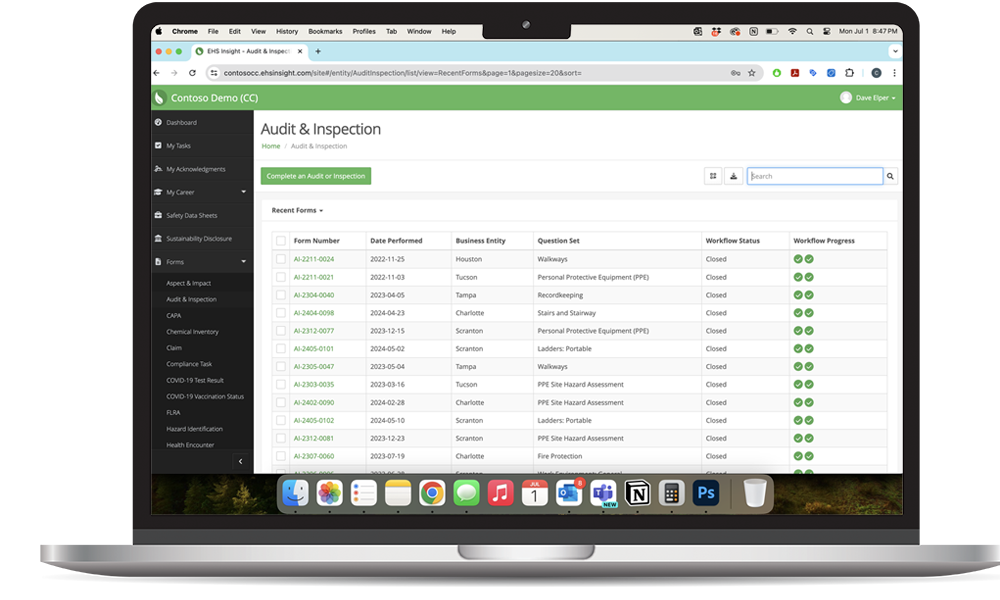
Inspections & Audits

FMCSA Part 396 DVIR requirements, terminal and yard facility inspections, and periodic vehicle maintenance audits generate high inspection volume that paper processes can’t track consistently.

Compliance Task Management

Incident Reporting & Investigation

FMCSA, DOT, FRA, and PHMSA compliance obligations run on driver-specific and vehicle-specific calendars. Centralizing them prevents the CDL renewal or drug test deadline that silently creates CSA exposure.

Work Observations

workobservation-Template-(1)

Driver behavior observation programs are the primary leading indicator in transportation. Capturing unsafe acts and conditions in the field before they produce a crash requires a tool that works from a phone, offline, in 30 seconds.

Training Management

Training & Qualifications

Driver qualification under FMCSA Part 391, entry-level driver training (ELDT) documentation, HazMat employee training, and ongoing safety training records all require documentation that proves competency, not just attendance.

incident-Template-(1)

CMV crashes, post-accident investigations, and FMCSA accident register obligations make incident capture and investigation the foundational requirement for any transportation safety program.

Inspections & Audits

FMCSA Part 396 DVIR requirements, terminal and yard facility inspections, and periodic vehicle maintenance audits generate high inspection volume that paper processes can’t track consistently.

Incident Reporting & Investigation

FMCSA, DOT, FRA, and PHMSA compliance obligations run on driver-specific and vehicle-specific calendars. Centralizing them prevents the CDL renewal or drug test deadline that silently creates CSA exposure.

workobservation-Template-(1)

Driver behavior observation programs are the primary leading indicator in transportation. Capturing unsafe acts and conditions in the field before they produce a crash requires a tool that works from a phone, offline, in 30 seconds.

Training & Qualifications

Driver qualification under FMCSA Part 391, entry-level driver training (ELDT) documentation, HazMat employee training, and ongoing safety training records all require documentation that proves competency, not just attendance.

Additional Modules Used Across Transportation Operations

Safety Meetings & Toolbox Talks

Pre-shift safety briefings, route hazard communications, and seasonal safety topics — log the topic, attendees, and any action items from the meeting digitally. Safety meeting completion rate by terminal and shift is a leading indicator that surfaces on the dashboard alongside observations and inspection completion.

Corrective and Preventative Action Management

Every inspection deficiency, incident finding, observation, and compliance gap generates a corrective action. EHS Insight tracks each CAPA from assignment to verified closure, with owner accountability and due date escalation. The closed-loop verification that the corrective action actually happened — not just that it was assigned — is what separates a defensible safety management system from a paper trail.

Contractor Management

Owner-operators, lease drivers, and subhauled freight create driver qualification file obligations and incident recordkeeping obligations for the carrier, not just the subcontractor. EHS Insight manages qualification records, COIs, and incident data for the full extended workforce.

Reporting & Analytics

TRIR, LTIR, DART, preventable crash rate, inspection completion rate by terminal and fleet segment, observation submission rate per driver, training currency by driver and credential type, CSA-relevant citation tracking, and open CAPA aging — built in and configurable. Executive dashboards for terminal manager, VP of Safety, and board-level ESG reporting.

Mobile-Ready & Offline. Built for Drivers and Field Teams. 

EHS Insight runs on iOS and Android, with native apps in the Apple App Store and Google Play. The full inspection, observation, incident, compliance check, and training delivery workflows run offline — completed records sync the moment the device reconnects. A driver completing a pre-trip inspection at 4 AM in a rural yard with no WiFi coverage needs the same inspection workflow as a driver at a connected terminal. A safety supervisor conducting a roadside observation in a dead zone needs the same submission capability as one in the yard. The platform is built around that reality.

Dashboards configure per role: a terminal safety manager sees today’s inspection completion rate, open observations, and CAPA status for their facility; a fleet safety director sees the network rollup with TRIR trend, training currency, and compliance task completion rate across all terminals; a VP of Safety sees the board-level scorecard. Everyone works from the same underlying data.

The Transportation Safety Metrics that Matter and How the Platform Moves Them 

In transportation, lagging indicators measure the crashes that already happened. Leading indicators, observations, inspection deficiency rates, training currency, compliance task completion are where the safety investment pays off before the crash occurs. The programs that move TRIR and preventable crash rate down consistently are the ones tracking both.

Lagging Indicators (Built-In Reporting)

  • TRIR: Total Recordable Incident Rate. Trucking and transportation post rates consistently above the all-industry average.
  • DART: Days Away, Restricted, or Transferred.
  • Preventable Crash Rate: total preventable crashes per million miles. The primary fleet safety performance metric for carrier benchmarking and insurance underwriting.
  • DOT Reportable Accident Rate: FMCSA-defined accidents involving fatality, injury requiring medical treatment beyond first aid, or disabling vehicle damage.
  • CSA BASIC Percentile Scores: tracked by violation category: Unsafe Driving, HOS Compliance, Driver Fitness, Controlled Substances/Alcohol, Vehicle Maintenance, Hazardous Materials, Crash Indicator.
  • Workers’ comp claim frequency and average cost per claim.

Leading Indicators (Where the Platform Pays for Itself)

  • Work observation submission rate per driver per month, the single most predictive leading indicator of crash rate reduction in transportation safety programs.
  • Pre-trip and post-trip inspection completion rate by driver, terminal, and fleet segment, especially the percentage of inspections that result in documented deficiencies vs. clean reports (too many clean reports is its own red flag).
  • Compliance task on-time completion rate: CDL renewals, MVR checks, drug test program deadlines, across driver-level and fleet-level obligations.
  • Training currency by driver and credential type, medical certificate days-to-expiry, HazMat recertification status, ELDT completion for new drivers.
  • CAPA closure rate and average time-to-close on inspection deficiencies and incident corrective actions.
  • Post-accident investigation completion rate within 48 hours, the window when root cause evidence is still recoverable and the preventable/non-preventable determination holds up.
  • Hellmann Worldwide Logo
  • Logistec Logo
  • Plastic Express Logo
  • Railserve Logo
  • UTLX Logo

What Our Customers Say:

"EHS Insight is working well for us. The ease of reporting through the app is very nice. In field CAPAs and full team involvement in inspections and audits is helping see real time hazard controls and improved communications."

"This is the 2nd employer I've initiated EHS Insight with. I love the software, but I especially love the team that makes this program possible. We're so happy to have replaced our old HSE management system with EHS Insight!"

“It is the most user-friendly system ever and makes life easy for EHS professionals.”

Transportation & Logistics Safety Software FAQ

What is transportation and logistics safety management software?

Transportation and logistics safety management software is a platform that helps trucking carriers, fleet operators, rail companies, and multi-modal logistics organizations manage EHS programs from a single system. It covers vehicle and facility inspections, incident and post-crash investigation, FMCSA and DOT compliance task tracking, driver behavior observations, training and qualification management, corrective action tracking, and regulatory recordkeeping. The goal is to replace paper DVIRs, spreadsheet-tracked driver files, and disconnected reporting tools with one auditable system that functions for drivers and field teams on any device, offline.

Does EHS Insight support FMCSA compliance for CMV carriers?

Yes. EHS Insight supports the full FMCSA compliance stack for commercial motor vehicle carriers: Part 382 drug and alcohol testing program documentation, Part 391 driver qualification file management (CDL, medical certificate, MVR, ELDT), Part 392 accident register and post-accident documentation, Part 395 hours of service compliance task tracking, and Part 396 DVIR and periodic inspection records. Every obligation is tracked in the compliance task module with owner assignment, due dates, and escalation alerts.

How does the Work Observations module work for driver safety programs?

Work Observations is a 30-second mobile submission from any supervisor, coach, or peer in the field: what was observed, who was involved, the hazard category, and what action was taken. It works offline. Both safe observations and unsafe observations are logged — because a program that only captures unsafe acts becomes disciplinary, not developmental, and submission rates drop. Observation data feeds a dashboard that surfaces patterns by driver, route, terminal, and time period. Coaching conversations are documented in the same record, creating a defensible paper trail of the safety management process.

Does it support DVIR and Part 396 inspection records for CMV fleets?

Yes. The Audit & Inspection Management module deploys pre-trip and post-trip inspection checklists on any mobile device. Deficiencies trigger a corrective action automatically with photo evidence and an assigned owner. Repair certification is documented in the same system as the original inspection. The full DVIR history for every vehicle is searchable and retrievable for FMCSA roadside inspection requests, periodic audit purposes, and litigation discovery.

Does it support rail operations and FRA compliance?

Yes. EHS Insight supports FRA compliance requirements including track inspection records, equipment inspection documentation, employee qualification records under 49 CFR Parts 240 and 242, and incident reporting under 49 CFR Part 225. The observation module captures near misses and unsafe conditions in rail yards and at grade crossings. The compliance task module manages FRA-specific recurring obligations alongside FMCSA and OSHA requirements in a single calendar.

How does it handle post-crash investigation and the FMCSA accident register?

EHS Insight captures first notice of loss data at the scene — vehicle, driver, location, conditions, witness information, and photos — in a single mobile incident record. The report auto-routes to the safety director, terminal manager, and compliance team. Root cause analysis, preventable/non-preventable determination, and corrective actions are documented within the same record. The FMCSA-required accident register is populated automatically from incident records, eliminating the manual year-end rebuild. Post-accident drug and alcohol testing obligation timelines are tracked within the incident workflow.

Does it work for owner-operators and subhauled freight?

Yes. EHS Insight manages driver qualification records, COIs, and incident data for owner-operators and subhaulers in the same system as company drivers. Carrier obligations for contractor driver qualification files under FMCSA Part 391 are tracked in the same compliance task register as direct employee obligations.

How long does implementation take?

EHS Insight is built for fast implementation. Most transportation customers are running their core modules — incident management, inspection management, compliance task tracking, observations, and training — within weeks, not months. Customer success and implementation support are included with every subscription.

What does it cost?

Request a custom quote and the team will scope pricing to your driver headcount, fleet size, terminal count, and module requirements.