OSHA
The Top OSHA Violations of 2019
Here’s a look at the most frequent OSHA violations of 2019 and what your safety team can learn from them.
5 minute safety talks are the best way to reinforce the importance of workplace safety. Here are some great topics for you to keep in mind.
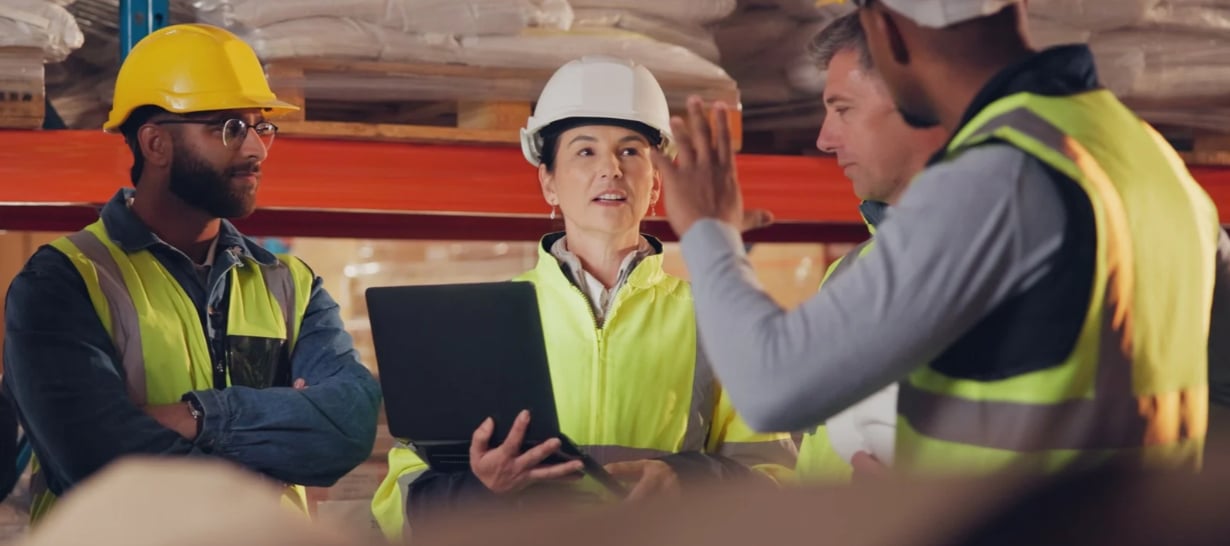
A 5-minute safety talk, also called a toolbox talk, tailgate talk or safety moment, is a short briefing on one hazard that a supervisor gives the crew at the start of work. Below are 20 topics, each with three talking points, the OSHA standard behind it and a question to ask your crew.
The first nine topics cover every standard on OSHA's preliminary list of the 10 most frequently cited standards for fiscal year 2026, which reflects federal OSHA inspections from October 1, 2025, through August 31, 2026. Those are the hazards inspectors cite most often, which makes them a practical place to start your rotation.
A safety talk is a focused, standing conversation held at the work area, usually before a shift or a new task. It covers one hazard the crew will face that day, not a full program. That narrow scope is what makes it different from a monthly safety meeting or a classroom course.
A safety talk does not replace training that a standard requires. Many OSHA standards specify training content, who delivers it and when. Forklift operator training under 29 CFR 1910.178 must combine formal instruction, practical training and an evaluation of the operator's performance in the workplace. Construction fall protection training under 29 CFR 1926.503 must be delivered by a competent person. A five-minute talk can reinforce that training between sessions. It cannot stand in for it.
Federal OSHA has no standard that requires toolbox talks by name or sets a weekly safety meeting schedule. You will see the claim that "OSHA requires weekly safety meetings" repeated online, but it does not appear in 29 CFR 1910 (general industry) or 29 CFR 1926 (construction).
What federal OSHA does require in construction is broader. 29 CFR 1926.21(b)(2) directs employers to instruct each employee in recognizing and avoiding unsafe conditions and in the regulations that apply to their work environment. Regular safety talks are one common way contractors support that duty and show they meet it.
Some state-plan states do set a frequency, and the trigger is usually the type of work:
If you operate in another state-plan state, check that state's construction and general industry rules directly. Customer contracts and general contractor site rules often require daily or weekly talks too. Those are contractual expectations, not OSHA requirements, but they are enforced the same way at the gate.
[SME QUOTE PLACEHOLDER: Eric Stevens or Gary McDonald, 1 to 2 sentences on what separates a safety talk crews remember from one they tune out. Attribute with name and title.]
For printable formats and sample scripts, see our toolbox talk templates and examples.
Topics 1 through 9 cover all 10 standards on OSHA's preliminary FY2026 list. Fall protection general requirements and fall protection training share Topic 1.
Fall Protection, general requirements (29 CFR 1926.501) is No. 1 on OSHA's preliminary FY2026 list, and Fall Protection Training (29 CFR 1926.503) is No. 8. The trigger height depends on the type of work: 6 feet above a lower level in construction, and 4 feet in general industry under 29 CFR 1910.28. Crews that move between plant work and project work mix these up.
Ask the crew: Where on this job could someone reach the trigger height without realizing it?
Ladders in construction (29 CFR 1926.1053) is No. 5 on the preliminary list. Two of its most practical rules: the top or top step of a stepladder may not be used as a step, and a portable ladder used to reach an upper landing must extend at least 3 feet above it, with limited alternatives when that is not possible. See 5 OSHA ladder rules to share with your team.
Ask the crew: Which ladder on this site is the wrong height for the job it is doing?
OSHA's Hazard Communication standard (29 CFR 1910.1200) is No. 2 on the preliminary list. HazCom training is event-driven, not annual: it is required at the time of initial assignment and whenever a new chemical hazard the employees have not been trained on is introduced into their work area. A talk is a good time to point out a new product, but the formal training still has to cover the content the standard lists.
Ask the crew: If this product splashed on you, where would you find what to do, and how long would it take?
The Control of Hazardous Energy standard (29 CFR 1910.147), known as lockout/tagout, is No. 3 on the preliminary list. Retraining for authorized and affected employees is required when job assignments change, when new machines, equipment or processes introduce a new hazard, when energy control procedures change, and when a periodic inspection shows deviations or gaps in knowledge.
Ask the crew: What energy does this machine still hold after it shuts off?
Respiratory Protection (29 CFR 1910.134) is No. 6 on the preliminary list. Employees who wear tight-fitting respirators must be fit tested before first use, whenever a different facepiece is used and at least annually after that. Respirator training is also required at least annually.
Ask the crew: When was your last fit test, and on which make, model and size?
Scaffolding in construction (29 CFR 1926.451) is No. 4 on the preliminary list. A competent person must inspect scaffolds before each work shift and after any occurrence that could affect structural integrity. Fall protection is required for each employee on a scaffold more than 10 feet above a lower level.
Ask the crew: Who is our competent person for scaffolds today, and how do you reach them?
Powered Industrial Trucks (29 CFR 1910.178) is No. 7 on the preliminary list. Trucks must be examined before being placed in service, daily, or after each shift where they run around the clock. Each operator's performance must be evaluated at least once every three years. See our forklift safety training checklist.
Ask the crew: Where on this floor do people and trucks share space without a marked lane?
Eye and Face Protection in construction (29 CFR 1926.102) is No. 9 on the preliminary list. General industry has a parallel standard, 29 CFR 1910.133.
Ask the crew: Which task today could put something in your eye?
Machine Guarding, general requirements (29 CFR 1910.212) is No. 10 on the preliminary list. Point-of-operation guarding, rotating parts and flying chips are the hazards it addresses most directly.
Ask the crew: Have you seen any machine here run without its guard? What was the reason?
OSHA's walking-working surfaces standard (29 CFR 1910.22) requires workplaces to be kept clean and orderly and walking surfaces kept free of hazards such as spills, leaks, loose boards, protruding objects, snow and ice.
Ask the crew: What is on the floor right now that should not be?
There is no specific OSHA standard for manual lifting in general industry. OSHA addresses ergonomic hazards under the General Duty Clause, Section 5(a)(1) of the OSH Act. For technique and training ideas, see mastering manual handling.
Ask the crew: Which lift on this job would you change if you could?
As of this update, there is no final federal OSHA heat standard. OSHA published a proposed rule, Heat Injury and Illness Prevention in Outdoor and Indoor Work Settings, on August 30, 2024. Until a final rule takes effect, OSHA cites heat hazards under the General Duty Clause. California, Washington and Oregon enforce their own heat illness rules.
Ask the crew: Who on this crew is new to working in this heat?
OSHA has no specific standard for cold stress, but the hazards are real for outdoor crews and anyone working in freezers or unheated buildings as temperatures drop.
Ask the crew: Where do we warm up on this site, and how often should we use it today?
OSHA's electrical safety-related work practices standards (29 CFR 1910.331 through 1910.335) allow only qualified persons to work on or near exposed energized parts. Unqualified employees working near overhead lines must keep at least 10 feet away from lines rated 50 kV or less, with larger distances for higher voltages.
Ask the crew: Where on this job could a ladder or boom get close to a power line?
Under 29 CFR 1910.242(a), employers are responsible for the safe condition of tools and equipment employees use, including tools employees bring from home.
Ask the crew: Which tool in your kit should not be there?
When an OSHA standard requires an emergency action plan, 29 CFR 1910.38 requires the employer to review the plan with each employee when the plan is developed or the employee is assigned, when the employee's responsibilities change, and when the plan changes.
Ask the crew: If the alarm sounded now, which exit would you use, and what if it were blocked?
OSHA groups falls, struck-by, caught-in or -between, and electrocution as the "Focus Four" hazards in construction. Struck-by and caught-in hazards also show up on plant floors around moving equipment and stored materials.
Ask the crew: Where today could you get caught between something moving and something that will not move?
OSHA's general PPE standard (29 CFR 1910.132) requires a workplace hazard assessment certified in writing, training before an employee does work that requires PPE, and retraining when changes make the earlier training obsolete or an employee shows they did not understand it.
Ask the crew: What PPE do you wear every day without knowing what it is rated for?
Section 11(c) of the OSH Act prohibits retaliation against employees for raising safety concerns, and OSHA's recordkeeping rule (29 CFR 1904.35) prohibits retaliation for reporting a work-related injury or illness. For ways to turn reports into improvements, see behavior-based safety observation examples.
Ask the crew: What almost went wrong this week that nobody wrote down?
General industry permit-required confined spaces fall under 29 CFR 1910.146. Construction has its own standard, 29 CFR 1926 Subpart AA. Both require atmospheric testing, a permit system and rescue planning for permit spaces.
Ask the crew: Which spaces on this site would you have to treat as permit spaces?
For more ideas outside the usual rotation, see 10 lesser-known safety topics for work huddles and our guide to safety meetings and toolbox talks.
A useful record captures the date, topic, leader, location and attendees, plus any questions raised and follow-up actions. Paper sign-in sheets are common, but they get lost, they are hard to search and they cannot show which employees missed last month's talks.
In EHS Insight, the Safety Meeting module records which documents were reviewed, who participated and when. A supervisor selects a talk from the Toolbox Talk document library, adds the crew as participants and submits the meeting from a mobile device. Crews can review documents online or offline. When signature collection is enabled, participants sign electronically, or add and sign their own entry by scanning a QR code.
Reports such as the Safety Meeting Personnel Record show an employee's full meeting history, and meeting counts can be reviewed by location and business entity. Toolbox Talk documents can move through draft and approval steps and carry a next review date, which helps keep your talk library current. If a talk reveals a training gap, the Training Management module supports One-Off Training Assignments for remedial training outside the regular schedule.
Five to 15 minutes. A 5-minute talk works for a single hazard tied to the day's work. Cal/OSHA's guidance on setting up tailgate meetings suggests keeping them short, usually 10 to 15 minutes, which leaves room for a demonstration or discussion.
Federal OSHA does not require toolbox talks by name or set a meeting frequency. Some state plans do: California requires toolbox or tailgate meetings at least every 10 working days for construction (Title 8, Section 1509), and Washington requires construction crew safety meetings at the beginning of each job and at least weekly (WAC 296-155-110).
It can support a general training duty, such as the construction requirement in 29 CFR 1926.21(b)(2) to instruct employees in recognizing and avoiding unsafe conditions. It cannot replace training a specific standard defines. Forklift operator training, for example, requires formal instruction, practical training and a workplace performance evaluation.
Federal OSHA sets no schedule, so frequency depends on state rules, contracts and how fast conditions change. Many employers hold talks at the start of each shift or weekly. Add a talk whenever a new chemical, machine, process or crew member arrives, since those changes also trigger HazCom training and lockout/tagout retraining.
Record the date, topic, leader, location, attendee names or signatures, questions raised and any follow-up actions. Washington requires minutes for construction crew safety meetings and requires employers to keep them for at least one year.
Pick a topic from this list, deliver it tomorrow and record who heard it. To see how the Safety Meeting module documents talks, signatures and participation across sites, take the instant demo.
Related articles:
Here’s a look at the most frequent OSHA violations of 2019 and what your safety team can learn from them.
Learn the Take 5 Safety framework and the construction injury statistics every EHS manager needs to brief workers on risks, falls, and chemical...
Workplace safety laws are designed to protect employees and employers alike, but you have to know what laws to follow. Here are a few to keep in mind.
Subscribe to our blog and receive updates on what’s new in the world of EHS, our software and other related topics.