Key Takeaways
Chemical container labeling is one of the most visible parts of a hazard communication program, and one of the easiest places for small gaps to turn into serious incidents. Clear, consistent labels give workers the information they need to handle chemicals safely, stay compliant with OSHA, and keep pace with how chemicals move through a facility.
- OSHA requires specific label elements on shipped containers, including product identifier, signal word, hazard statements, pictograms, precautionary statements, and manufacturer contact information, with signal words, hazard statements, and pictograms grouped together.
- Secondary containers still need labels in most cases under 29 CFR 1910.1200(f)(6), even when teams rely on a simplified workplace label format.
- The "immediate use" exemption is narrow. It only applies when one worker transfers, controls, and uses the chemical within a single shift, and it disappears the moment any of those conditions change.
- The 2024 HazCom update adds flexibility for small containers, allowing abbreviated labels on containers of 100 mL or less and limited labeling on very small containers where space is restricted.
- Handwritten or shortcut labels create risk. Vague product names, missing hazard information, and outdated labels are common failure points that lead to confusion and exposure.
- Labeling works best as part of a connected system. Aligning chemical inventories, SDSs, training, and field access reduces drift between what's on the label and what's in the program.
- EHS Insight brings labeling, SDSs, and hazard communication into one platform, so field teams, multiple sites, and growing chemical inventories stay in sync without adding manual work.
Why Is Chemical Container Labeling Critical for Workplace Safety?
A chemical label does more than name what’s inside a container. It gives workers the information they need to recognize hazards quickly and handle materials the right way. When labels are clear and consistent, workers can make safe decisions without stopping to guess.
Problems start when labels are missing, faded, or unclear. In those moments, people rely on memory or assumptions, and that’s where risk increases. The U.S. Chemical Safety Board documented a fatal incident involving a mislabeled cylinder that released a toxic mixture containing antimony pentachloride, showing how a simple labeling failure can lead to serious consequences.
Chemical labeling also plays a direct role in compliance. Under OSHA’s Hazard Communication Standard (29 CFR 1910.1200), employers must maintain a written program, keep safety data sheets accessible during each shift, and train workers on chemical hazards. OSHA’s HazCom overview reinforces that labels, SDSs, and training must work together to protect employees.
That’s the baseline requirement, but real workplaces add complexity. Chemicals move between containers, across teams, and through different stages of work, so labeling has to stay accurate and visible at every step to keep risk under control.
What Information Does OSHA Require on Chemical Container Labels?
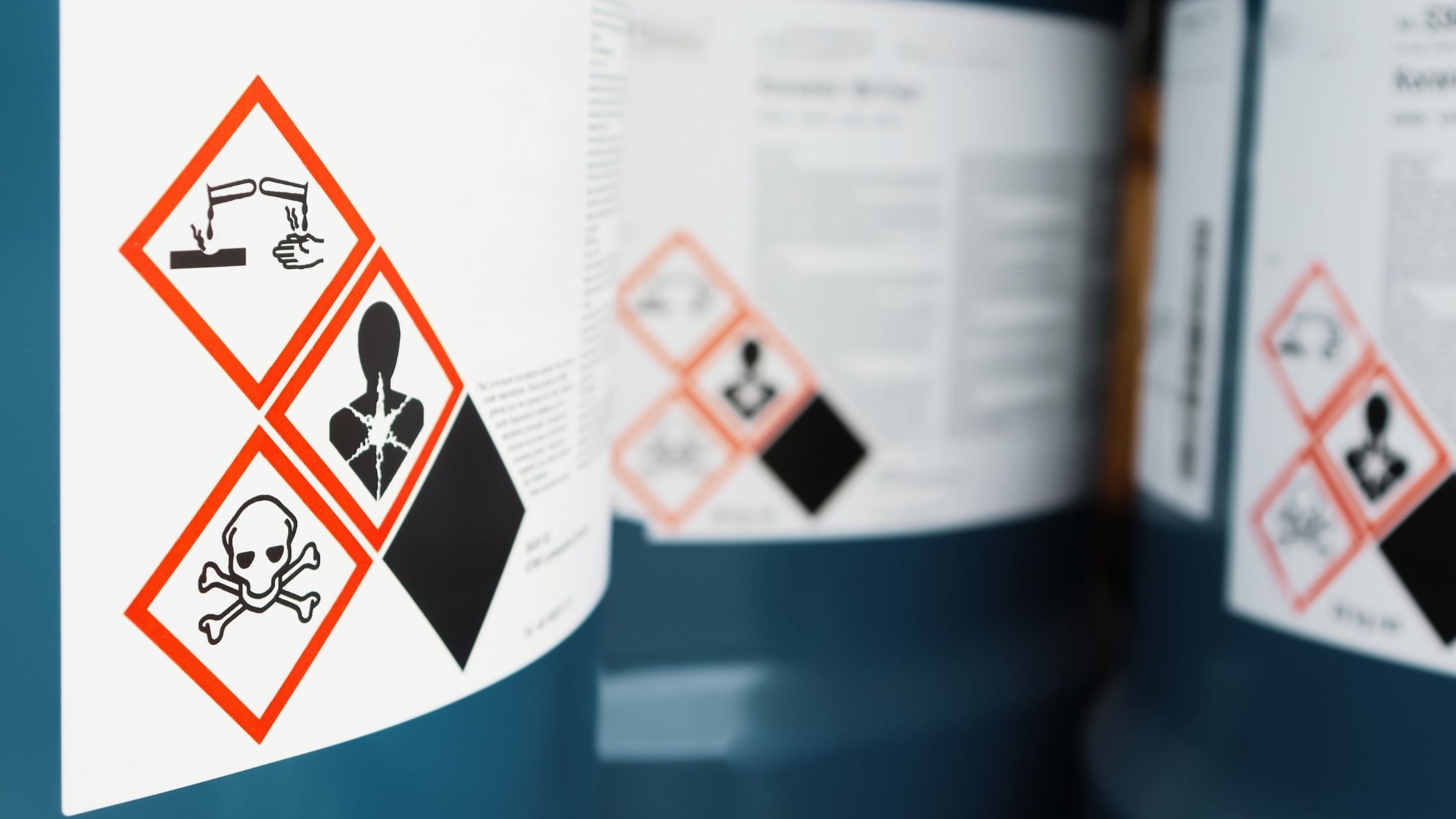
OSHA requires chemical container labels to give workers clear, consistent hazard information the moment they see a product. Under the Hazard Communication Standard (29 CFR 1910.1200(f)(1)), shipped containers must include a complete set of standardized elements that work together to communicate risk quickly and clearly.
These required elements include:
- Product identifier
- Signal word, such as “Danger” or “Warning”
- Hazard statements
- Pictograms
- Precautionary statements
- Manufacturer or responsible party contact information
OSHA also requires key elements like the signal word, hazard statements, and pictograms to appear together. That way, workers don’t have to search across the label to understand the main hazard before handling the chemical.
To keep labeling consistent across industries, OSHA ties each hazard classification to specific label language. Appendix C of the standard outlines exactly which signal words, pictograms, and hazard statements apply, and it includes an important rule many teams miss. If a label uses “Danger,” it cannot also include “Warning,” which prevents mixed or confusing messages.
OSHA’s 2024 update builds on this structure by addressing common challenges in the field. It allows abbreviated labels for small containers under 100 mL and limited labeling for very small containers when space is restricted. It also extends compliance deadlines into 2026 and beyond, giving companies more time to adjust their labeling systems without disrupting operations.
All of this matters because the shipped label often becomes the reference point for everything that follows. When that information is applied correctly, it creates consistency across containers, safety data sheets, and training. When it isn’t, small labeling gaps can spread quickly and create confusion across the workplace.
Do Secondary Chemical Containers Need OSHA-Compliant Labels?
Most labeling issues show up during everyday tasks, especially when chemicals get transferred into secondary containers. These containers may seem low risk, but OSHA still requires them to be labeled in most cases under 29 CFR 1910.1200(f)(6).
OSHA allows some flexibility in how workplace labels are created, but they still need to communicate key information clearly. At a minimum, a compliant secondary container label should include:
- A product identifier that matches the chemical
- Clear hazard information using words, symbols, or both
- Enough detail for workers to understand the risk at a glance
That flexibility often leads to confusion. Some teams assume a quick handwritten label is enough, but it only works if it clearly communicates the hazard and connects back to the full hazard communication program. OSHA reinforced this in its 2017 interpretation letter, explaining that simplified labels are acceptable only when workers can still access complete hazard information through the system.
Think about a common scenario. A worker pours a degreaser into a spray bottle for routine use. If the label only says “degreaser,” it leaves too much room for guesswork. A label that identifies the specific product and signals the hazard gives workers a clearer path to handle it safely and avoid mistakes.
When Are Portable Chemical Containers Exempt From Labeling Rules?
OSHA allows a limited exception for portable containers, but it only applies in very specific situations. Under 29 CFR 1910.1200(f)(8), a label is not required when one employee transfers a chemical into a container and uses it immediately during the same shift.
For this exception to apply, three conditions must stay true:
- The same employee transfers and uses the chemical
- The container stays under their control at all times
- The chemical is used within the same work shift
Once any of these conditions change, the exemption no longer applies. If the container is left unattended, shared with another worker, or used beyond the same shift, it must be labeled to prevent confusion and potential exposure.
How Can EHS Insight Improve Chemical Labeling and Compliance?
EHS Insight gives you a better way to manage labeling as part of a connected system, not a standalone task. It brings your chemical data, safety processes, and field activity into one place so nothing falls out of sync.
With EHS Insight, your team can:
- Keep chemical inventories, labels, and SDSs aligned across every site
- Ensure workers can access up-to-date safety data during every shift
- Standardize workplace labeling practices, even with multiple teams and locations
- Track changes in hazard information and trigger updates before gaps appear
- Support field teams with mobile access, even in remote or offline environments
- Connect training, inspections, and corrective actions to your hazard communication program
As your operation grows, labeling gets more complex. More chemicals, more transfers into secondary containers, and more chances for things to slip through. EHS Insight helps you stay organized and in control, without adding more manual work.
If you want to reduce labeling errors, strengthen hazard communication, and make compliance easier to manage, EHS Insight can help you get there. Explore EHS Insight today and see how you can build a labeling program that works in the real world.
FAQ
What is the difference between a shipped container label and a workplace label?
A shipped container label includes full OSHA elements like signal word, hazard statements, pictograms, and manufacturer details. A workplace label can be simpler, but it must still identify the chemical and clearly communicate its hazards so workers can handle it safely.
When do I need to label a secondary container?
You must label a secondary container any time a chemical is transferred and used beyond immediate control. If the container leaves the person who filled it or stays in use beyond the same shift, it needs a clear label with the product name and hazard information.
What is considered “immediate use” under OSHA labeling rules?
Immediate use means one worker transfers a chemical into a container and uses it right away during the same shift while keeping it under their control. If the container is shared, stored, or used later, it no longer qualifies and must be labeled.
How do small container labeling rules work under OSHA?
For containers of 100 mL or less, OSHA allows abbreviated labels when space is limited. Very small containers, 3 mL or less, may only need a product identifier if a full label would interfere with normal use, but full details must still appear on the outer packaging.
What are the most common chemical labeling mistakes in the workplace?
Common mistakes include missing labels on secondary containers, inconsistent product names across labels and SDSs, outdated labels after hazard changes, and relying on memory instead of a system. These gaps often lead to confusion, improper handling, and increased risk of exposure.