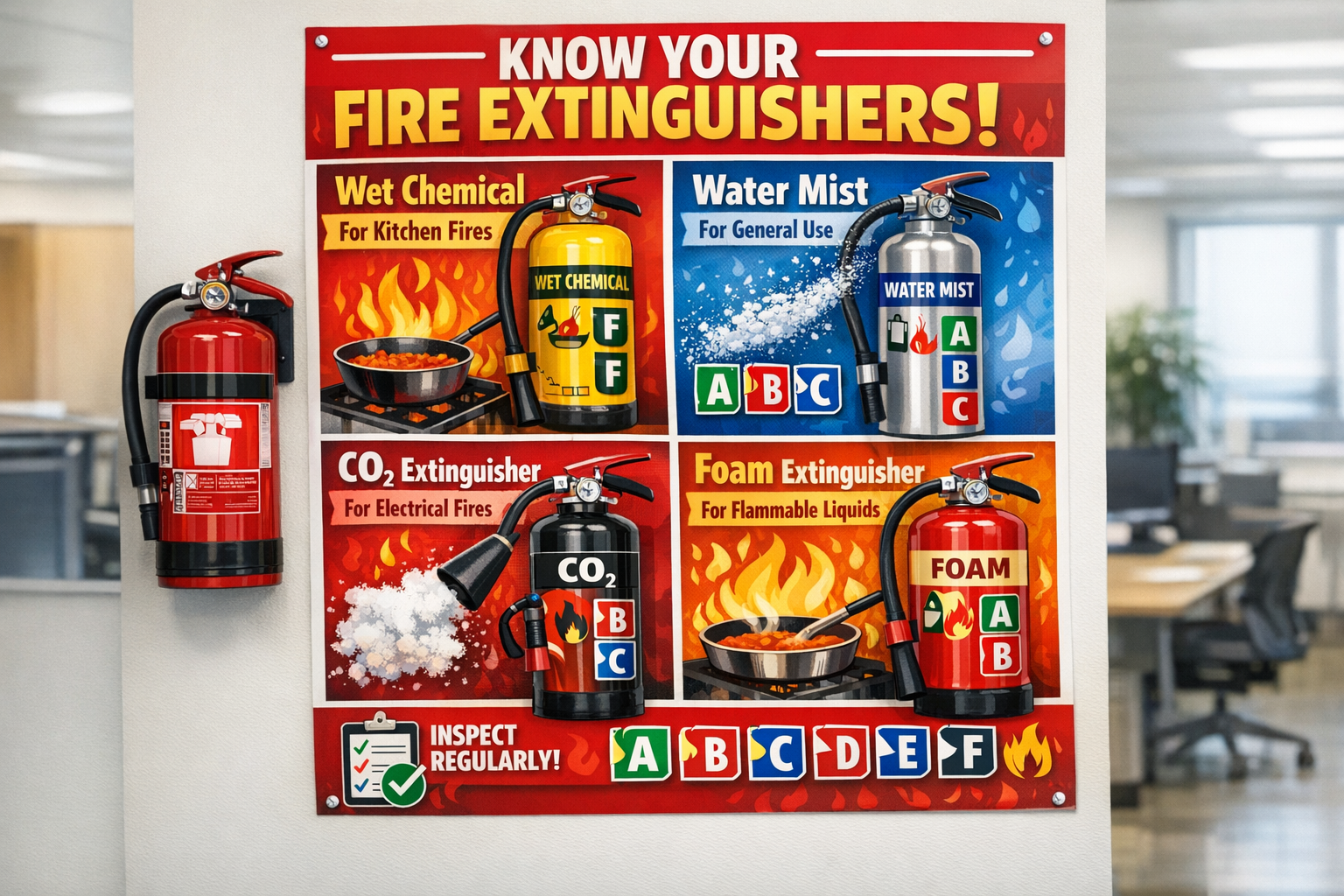
Fire extinguishers are a legal and practical requirement in every workplace — but choosing the wrong type can make a fire worse, not better. This guide explains the four main types of workplace fire extinguishers, what each one is used for, and how to select the right one for your environment.
What Are the Different Types of Fire Extinguishers Used in the Workplace?
There are four primary types of fire extinguishers used in workplace settings:
- Wet Chemical Extinguishers — best for kitchen and cooking oil fires
- Water Mist Extinguishers — versatile; effective on most fire classes including electrical
- Carbon Dioxide (CO₂) Extinguishers — designed for electrical and flammable liquid fires
- Foam Extinguishers — suited for flammable liquid and solid material fires
The correct type depends on the fire classes most likely to occur in your specific work environment.
Why Does Fire Extinguisher Type Matter?
Not all fires are the same. Fires are classified by their fuel source:
- Class A — combustible solids (wood, paper, cardboard)
- Class B — flammable liquids (petrol, solvents)
- Class C — flammable gases
- Class D — combustible metals
- Class E — electrical equipment fires
- Class F — cooking oils and fats
Using the wrong extinguisher on the wrong fire class can be ineffective or dangerous. For example, a standard water extinguisher used on an electrical fire can cause electrocution. Selecting the right type is a core workplace safety responsibility for managers and supervisors.
Wet Chemical Fire Extinguishers
Best for: Class F (cooking oils and fats), Class A (wood, paper) Most commonly found in: Commercial kitchens, canteens, food preparation areas
Wet chemical extinguishers contain a solution of alkali salts mixed with water. When discharged, they produce a fine mist that:
- Knocks down flames rapidly
- Cools the burning oil below its ignition point
- Forms a soapy layer on the surface that seals the fuel and prevents reignition
This dual action — suppression and prevention — makes wet chemical extinguishers the safest and most effective choice for cooking-related fires.
Not suitable for: Electrical fires, flammable liquid fires, or metal fires.
Water Mist Fire Extinguishers
Best for: Class A, B, C, and E (including electrical fires) Most commonly found in: Mixed-use workplaces, hospitals, offices with server equipment
Water mist extinguishers are among the most versatile fire extinguishers available. They discharge de-mineralised water as a microscopic fog that works in two ways:
- Oxygen displacement — the fog reduces oxygen concentration around the fire, suffocating it
- Thermal cooling — the water absorbs heat, lowering the fire's temperature
The key differentiator is the de-mineralisation process. Removing minerals from the water makes it non-conductive, which means water mist extinguishers are safe to use on electrical fires — a capability most water-based extinguishers do not have.
Not suitable for: Class D (metal) fires or Class F (cooking oil) fires.
Carbon Dioxide (CO₂) Fire Extinguishers
Best for: Class E (electrical equipment), Class B (flammable liquids) Most commonly found in: Server rooms, electrical panels, laboratories, workshops
CO₂ extinguishers work by displacing the oxygen that sustains a fire. Key advantages include:
- Zero residue — leaves no powder, foam, or liquid behind
- No electrical conductivity — safe for use on live equipment without risk of short circuits
- Equipment-safe — will not damage sensitive electronics or machinery
- Effective in confined spaces — the gas spreads efficiently in enclosed areas
Important limitation: CO₂ extinguishers do not prevent reignition. Because they leave no suppressing agent on the fuel source, the fire can restart once CO₂ disperses. The underlying hazard must be eliminated immediately after use.
Not suitable for: Class A (solid material) fires or Class F (cooking oil) fires.
Foam Fire Extinguishers
Best for: Class B (flammable liquids and gases), Class A (wood, paper) Most commonly found in: Warehouses, manufacturing floors, storage areas
Foam extinguishers discharge an aqueous film-forming foam (AFFF) that:
- Blankets the fuel surface, cutting off the oxygen supply
- Cools the fire through the water content in the foam mixture
- Seals vapours from flammable liquids, reducing the risk of reignition
Note on electrical fires: Some foam extinguishers carry an electrical safety rating, but this is not universal. Unless a foam extinguisher is explicitly rated for electrical use, it should not be used on Class E fires.
Key downside: Foam leaves a significant residue that requires professional clean-up, which can affect equipment and increase post-incident costs.
Not suitable for: Class D (metal) fires or Class F (cooking oil) fires. Check rating before using on Class E.
Which Fire Extinguisher Is Right for Your Workplace?
| Fire Extinguisher Type |
Class A |
Class B |
Class C |
Class D |
Class E (Electrical) |
Class F |
| Wet Chemical |
✅ |
❌ |
❌ |
❌ |
❌ |
✅ |
| Water Mist |
✅ |
✅ |
✅ |
❌ |
✅ |
❌ |
| Carbon Dioxide (CO₂) |
❌ |
✅ |
❌ |
❌ |
✅ |
❌ |
| Foam |
✅ |
✅ |
❌ |
❌ |
⚠️ If rated |
❌ |
How to choose:
- Identify the fire classes most likely to occur in your workplace
- Match those classes to the extinguisher type(s) in the table above
- Ensure the correct extinguisher is mounted, signed, and accessible in each risk zone
- In manufacturing environments, multiple extinguisher types may be required across different areas
Frequently Asked Questions
Can I use a CO₂ extinguisher on a wood fire? No. CO₂ does not have a cooling or coating effect on solid fuels and will not reliably suppress Class A fires.
What type of fire extinguisher is used in kitchens? Wet chemical extinguishers are the standard for commercial kitchens due to their effectiveness on cooking oil (Class F) fires.
What fire extinguisher is safe for electrical fires? Both CO₂ extinguishers and water mist extinguishers are safe for electrical fires. CO₂ is the traditional choice; water mist is the more versatile modern alternative.
Do all workplaces need more than one type of extinguisher? In many workplaces — particularly manufacturing, industrial, and commercial kitchens — yes. A fire risk assessment will identify which fire classes are present and where each extinguisher type should be positioned.
How to Maintain Workplace Fire Safety Beyond Extinguisher Selection
Selecting the right extinguisher is one component of a broader fire safety programme. Effective workplace fire safety also requires:
- Regular fire risk assessments documented and reviewed annually
- Employee training on extinguisher use, fire classes, and evacuation routes
- Monthly visual inspections and annual servicing of all extinguishers
- Incident and near-miss reporting to identify trends before they become emergencies
- A centralized safety management system to track hazards, inspections, training records, and compliance obligations in one place
A robust safety management system reduces administrative burden, improves compliance visibility, and helps organizations identify risk patterns before incidents occur.
For guidance on fire safety compliance, extinguisher placement, or implementing a safety management system, contact a qualified workplace health and safety professional.