Where Most of My Day Actually Happens Now
My day-to-day work has shifted tremendously toward AI over the past year. I draft, analyze, plan, and think alongside Claude and ChatGPT. The interface that used to be Word, Slack, and a browser tab is increasingly an AI chat window. When I want to understand something, I ask. When I want to draft something, I draft alongside an assistant. I am not unusual. The people who run safety programs, finance teams, operations groups, and engineering functions are all having a version of this same experience.
Which raised a question for us. If our customers are spending their day in Claude, ChatGPT, and Microsoft Copilot, why are we still asking them to come into EHS Insight every time they need to ask their EHS program a question?
The Question We Were Trying to Answer
A safety manager’s job involves answering questions from other people. All week long. Someone in operations asks for incident trends in a specific region. HR asks which corrective actions are overdue. Finance asks for the recordable rate to drop into a presentation. The manager logs into EHS Insight, finds the right report, applies the right filters, exports the data, and reformats it for whoever asked.
That cycle has real costs. The mental overhead of knowing which report to run is one. The context switching is another. But the most expensive part is the reformatting. Reformatting is the work that Claude and ChatGPT do better than anything else. We wanted to know what would happen if we put that work where it actually belonged.
The answer turned out to be the Model Context Protocol.
What MCP Is
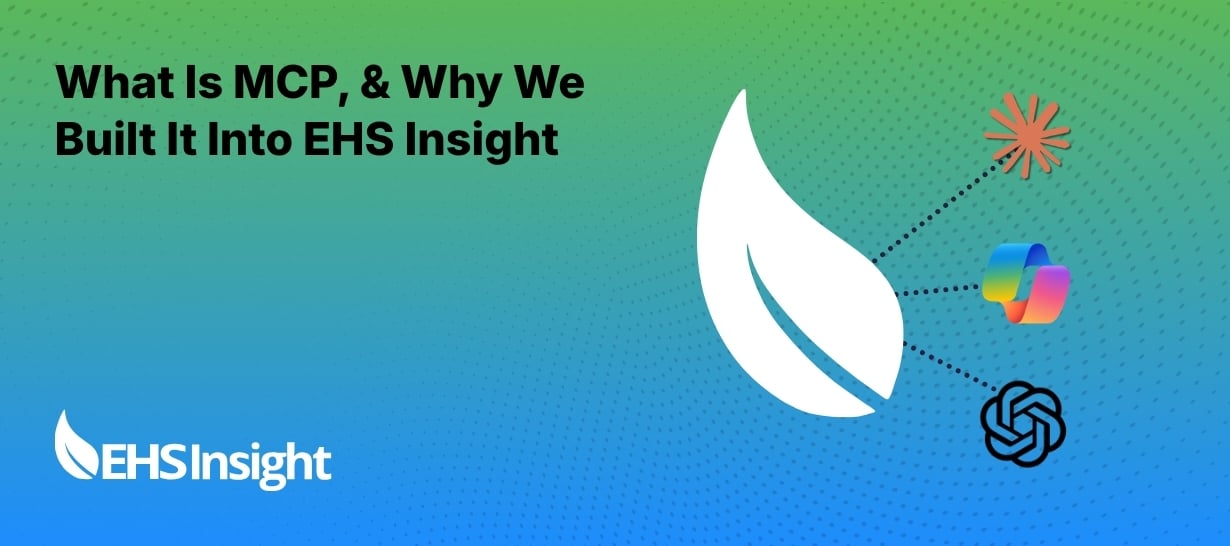
MCP stands for Model Context Protocol. It is an open standard that lets AI assistants like Claude, ChatGPT, and Microsoft Copilot connect directly to external software systems and query data in real time. The simplest analogy is the way those AI assistants already search the internet to answer questions you ask them. MCP works the same way, except instead of pointing at the open web, it points at your EHS Insight data through a secure protocol that is scoped to each user’s permissions.
Practically, here is what that means. Starting now, a customer can connect EHS Insight to Claude in under a minute. They open a chat. They type something like, show me all overdue corrective actions from our Q2 audits. They get an answer drawn directly from their EHS Insight data, right there in the AI assistant they were already using. The cognitive overhead of knowing which report to run, which filters to apply, and how to reformat the data is gone. You ask the question. The AI knows where to look. If the question requires pulling from multiple modules or fetching multiple individual records, the AI does that work for you.
“The cognitive overhead of knowing which EHS Insight reports to run, which filters to apply, how to reformat that data, all of that is gone. You just ask the question. The AI knows where to look.”
- Eric Stevens, Chief Technology Officer, EHS Insight
How MCP Fits With the AI We Already Have
EHS Insight has been building AI into the product for years. It is worth being precise about what those existing capabilities are, because the question we get most often is whether MCP replaces them. It does not. MCP fits alongside them.
The first kind of AI in EHS Insight is what I would call task assistant AI. These are purpose-built models and agents that help users work better inside the platform. They review an incident description and flag concepts the user may have omitted. They recommend corrective actions based on photos attached to an investigation. They deconstruct a permit into its underlying obligations and compliance tasks. They are not general-purpose tools. They are trained for specific EHS workflows, and they live in the moments where users need them.
The second kind is analytical AI. These are capabilities that help users search their data, surface trends, and generate reports without manually building every query or every export. The intelligence that helps a user understand what their EHS program is telling them, while they are working in EHS Insight.
MCP overlaps with and extends that second kind. It brings those analytical capabilities out into whatever AI assistant the user is already working in. The advantage is that EHS data stops being siloed inside the AI capabilities of EHS Insight. A safety manager can pull live EHS Insight data into the same conversation where they are already drafting an executive summary, replying to an email, or updating slides in a PowerPoint that already exists.
“Built-in platform AI features continue to be purpose-built and precise, focused primarily on getting high-quality data into the system. The MCP connector is what makes that high-quality data available out where information workers are already working.”
- Eric Stevens, Chief Technology Officer, EHS Insight
That is the architecture story. Built-in platform AI gets high-quality data into the system. MCP makes that high-quality data available out where information workers already work. Both matter. They are growing on different tracks.
Why We Built on an Open Standard
The AI ecosystem is moving fast. The models that are state of the art today are not the models that will be state of the art in twelve months. Any vendor who builds a proprietary copilot into their product is signing up for a treadmill. Every time the underlying AI capability advances, they have to rebuild to keep pace. We did not want to be on that treadmill. We did not want to put our customers on it either.
An open protocol changes both equations. MCP is the protocol, not the AI. Whatever AI tool wins, our integration works. Whatever AI capability advances, our customers benefit from it automatically, with no work from us and no upgrade cycle for them. The platform got better while they were sleeping. So did their EHS analysis.
The Question About Data Security
Whenever we describe MCP to a customer, the conversation eventually turns to security. It is the right conversation to have. Our customers manage incident records, audit data, and compliance evidence that is genuinely sensitive. Putting any of that data in front of any new system is a question that deserves a careful answer.
The starting point is that most enterprise organizations have already answered the foundational question. If your company is running Claude Enterprise, ChatGPT Enterprise, or Microsoft Copilot, you already have an enterprise agreement that governs how those tools handle your data. Your security and legal teams have already reviewed that contract. The data your team is sending into those AI tools today is being governed by an agreement you control.
MCP moves EHS Insight data into a system that you already control and have already made governance decisions about. That is a different risk profile than a lot of other arrangements.
At the protocol level, MCP allows Claude (or ChatGPT, or Copilot) to query EHS Insight servers using the authenticated user’s credentials. The AI gets back exactly what the user’s roles and permissions already allow. Nothing more. If a user does not have permission to see PII fields in EHS Insight, their AI session will never receive that data. The permission model is strictly enforced at the query layer.
Everything is audit-logged. An AI assistant querying EHS Insight through MCP follows all of the same rules and looks nearly identical, from a compliance perspective, to a user querying through the interface or a developer accessing the API. Same access controls. Same audit trail.
And here is the part that often surprises people. The alternative to MCP, in most organizations, is not no AI. It is people exporting EHS data to Excel and uploading it into ChatGPT. That is happening right now in companies that have never reviewed it, never approved it, and have no log of it. MCP is the governed, audit-logged replacement for that workflow. It is, in real terms, a security upgrade.
“MCP is a governed, structured, secure way of connecting EHS Insight data into an enterprise AI tool that employees are already using. It is so much better than the alternative of having users export data to countless Excel files and uploading them to ChatGPT over and over.”
- Eric Stevens, Chief Technology Officer, EHS Insight
The Skeptic’s Question, and the Right Way to Answer It
Some safety leaders are skeptical that AI belongs anywhere near a compliance program. I understand the instinct. The compliance function exists to be rigorous, conservative, and defensible. Adding a probabilistic system to that picture sounds, on its face, like making things worse.
My answer is that the question is not whether AI should touch our compliance data. It is how we make sure that it happens responsibly. That is the question to zero in on.
MCP does two things that make AI responsible in a compliance context. The first is the security side, which we just covered. The second is more subtle and, in some ways, more important. MCP gives the AI better context, which makes it more accurate.
If you are uploading small chunks of data into ChatGPT to ask it for analysis, the AI is not seeing the full picture. It does not have the relationships between records. It does not know that this incident and that work observation are connected through the same employee. It does not know that this corrective action is tied to that audit finding. With MCP, the AI sees the relational and semantic context that you cannot get by exporting and importing data. The same connection that makes MCP more secure also makes it more accurate. Both sides of that statement matter.
What This Looks Like in Practice
The simplest version of what MCP unlocks is the question I used earlier: show me all overdue corrective actions from our Q2 audits. That is a question a safety manager fields every week. Today it requires logging in, filtering the audit report, exporting the result, and reformatting it for whoever asked. With MCP, the user asks. The AI returns the answer. Total time: seconds, not minutes.
A more interesting example is a question no dashboard can answer in any reasonable amount of time. Imagine asking: find any EHS incident where the injured person was the observed person on a work observation within the two weeks prior to their injury. That question requires correlating across two modules, matching records at the person level, applying a time-window filter, and presenting the result.
Through MCP, Claude takes the metadata our MCP server provides, creates a multi-step plan, runs API queries, executes reports, hits a roadblock, compensates for it, and collates the data into an answer. All of that happens inside the chat window, in front of the user, while they watch. It feels less like running a query and more like working with a sharp analyst who knows your data.
The third example is the one that lands in executive meetings. Ask: which business entities have seen worsening incident rates, which have seen worsening Work Observation participation, and is there a correlation? That is a board-deck-grade question. The AI pulls trend data across two domains, looks for correlation, and presents a leadership-ready answer. It is the question that turns MCP from a productivity feature into a strategic capability.
Where This Goes
Everything I have described so far is focused on analyzing data. That is what the current version of MCP enables, and the runway in that direction is enormous. The AI tools your team uses are better today than they were a year ago, and they will be better still a year from now. MCP lays the groundwork that gives those agents access to the context and the data they need to be useful. As they continue to advance, your EHS Insight experience advances with them, automatically.
There is another part of the MCP story that we are actively working on now. I am not going to preview specifics here, because the work is still in progress. What I will say is that the architectural bet we made on an open protocol creates space for capabilities that closed, in-app copilots cannot offer. We will share more when it is ready.
Try It
If you are an EHS Insight customer, your account team can walk you through enabling the MCP connector. If you are evaluating EHS Insight, we would be glad to show you what it looks like in your AI tool of choice.
The setup is genuinely under a minute. Open Claude, ChatGPT, or Microsoft Copilot. Add EHS Insight as a connector. Log in. Approve. Start asking. The AI does the rest.