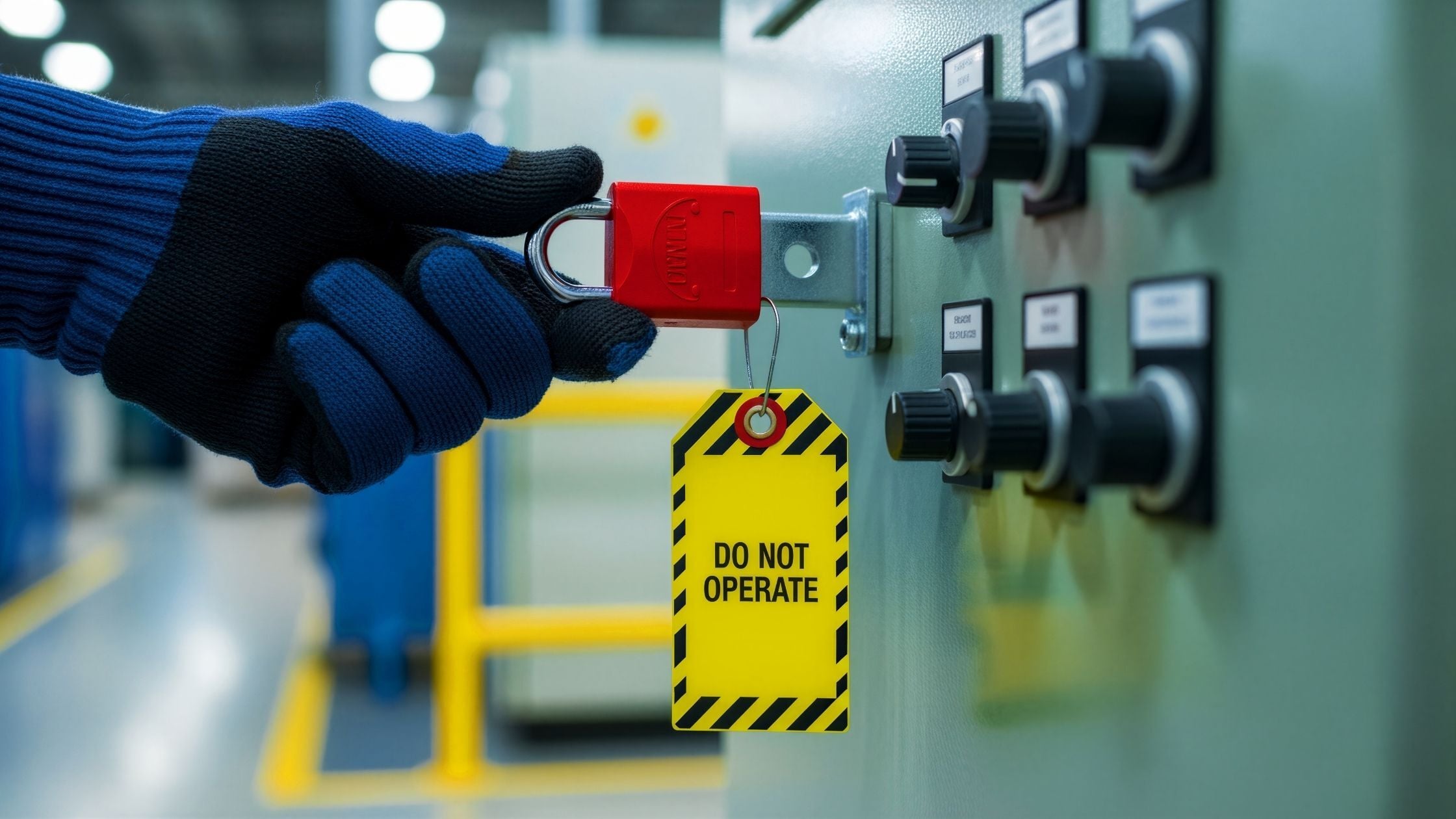
A safe work permit is a written authorization that documents hazards, controls, and personnel responsibilities before workers enter a high-risk area or perform a dangerous task. OSHA requires permits for three of the most hazardous work categories in general industry: permit-required confined spaces (29 CFR 1910.146), hot work such as welding and cutting (29 CFR 1910.252), and lockout/tagout for hazardous energy control (29 CFR 1910.147). Getting these right isn't paperwork, it's how workers come home.
Key Takeaways
- Permit-required confined spaces, hot work, and lockout/tagout each have distinct OSHA permit requirements with specific fields that must be documented.
- More than 90 workers die in confined spaces annually in the U.S.; over 60% of those fatalities are would-be rescuers who entered without proper training or equipment.
- Hot work fatality risk exceeds four deaths per 1,000 workers over a working lifetime, one of the highest in general industry.
- Lockout/tagout compliance prevents an estimated 120 deaths and 50,000 injuries per year, yet LOTO (29 CFR 1910.147) ranked fifth among OSHA's most-cited standards in FY 2024.
- Digital permit management software replaces paper-based systems that allow permits to go missing, expire unnoticed, and create documentation gaps during audits.
What Is a Permit-Required Confined Space?
Under 29 CFR 1910.146, a space qualifies as a permit-required confined space (PRCS) if it meets all three of the following criteria and contains at least one serious hazard:
- Large enough for an employee to enter and perform assigned work
- Limited means of entry or exit
- Not designed for continuous employee occupancy
The space also must contain at least one of the following:
- A substance capable of engulfing or suffocating an entrant (atmospheric hazard, liquid, or flowable solid)
- Inwardly converging walls or a sloped floor that narrows toward a smaller cross-section
- Any other recognized serious safety or health hazard
Common examples include sewers, storage tanks, boilers, process vessels, manholes, crawl spaces, attics, and pits.
What Are Employer Responsibilities for Confined Spaces?
The employer must evaluate the workplace to identify any spaces that qualify as permit-required. Where PRCS exist, the employer must:
- Post signs at each space identifying its location and hazards
- Prevent unauthorized entry or establish a written permit program that controls authorized entry
- Make the permit program available for review by employees and their authorized representatives
The construction industry standard, 29 CFR 1926.1206, adds one critical requirement not in the general industry standard: employers must monitor for atmospheric hazard changes if the ventilation system fails, and must alert employees immediately in the event of failure.
What Must a Confined Space Entry Permit Include?
Per 29 CFR 1910.146(f), every entry permit must document the following:
| Field |
Purpose |
| Space to be Entered |
Ties the permit to the specific location |
| Reason for Entry |
Must be descriptive, "replacing communications cable in the sewer line," not "working in sewer line" |
| Authorized Date and Duration |
Bounds the window of permitted entry |
| Names of Authorized Entrants |
Enables accountability and rescue identification |
| Names of Attendants |
Documents who is monitoring from outside |
| Entry Supervisor Name and Signature |
Confirms authorization chain |
| Identified Hazards of the Space |
Forces documented hazard assessment before entry |
| Precautions Used to Isolate and Control Hazards |
Documents control measures taken |
| Acceptable Entry Conditions |
Defines the baseline that must be met before entry |
| Atmospheric Test Results, Tester Initials, and Test Times |
Creates a record of conditions at time of entry |
| Rescue and Emergency Services and How to Summon Them |
Ensures rescue is pre-planned, not improvised |
| Communication Procedures Between Entrants and Attendants |
Defines the check-in protocol |
| Equipment Required, Including PPE |
Documents what was issued and used |
| Any Additional Required Permits, Including Hot Work Permits |
Flags permit interdependencies |
One additional requirement: entrance covers on PRCS must remain in place except during authorized entry and exit. If removing the cover itself creates a hazard, that hazard must be eliminated before the cover comes off.
Note on pre-entry assessment: If you need to enter a space to determine whether it qualifies as a PRCS, no permit is required for that initial assessment entry. The permit requirement applies once the space is classified.
For a reusable confined space entry permit template that covers all 1910.146(f) fields, EHS Insight provides a customizable version built for field use.
What Is a Hot Work Permit and When Is One Required?
Hot work refers to any operation capable of producing an ignition source, most commonly welding, cutting, and brazing. OSHA 29 CFR 1910.252 governs hot work in general industry and applies regardless of industry type. OSHA reports that the fatality risk for welding, cutting, and brazing exceeds four deaths per 1,000 workers over a working lifetime, one of the highest occupational risk rates in general industry.
Before any hot work begins, the employer must inspect the work area and document all precautions in a written permit.
Fire Prevention and Protection: The Decision Hierarchy
When assessing a hot work area, apply this hierarchy in order:
- Relocate the work. If the object to be welded or cut can be moved to a safe area, move it.
- Relocate the hazards. If the work can't move, eliminate fire hazards from the vicinity.
- Install guards. If neither the work nor the hazards can be moved, install shielding that confines sparks, heat, and slag away from combustibles.
- Don't do the work. If none of the above is achievable, hot work must not proceed in that area.
Hot work is prohibited in all of the following situations:
- Areas where management has not authorized cutting or welding
- Buildings where sprinkler systems restrict those activities
- Areas with explosive atmospheres (flammable gases, dust, vapors, or liquids)
- Locations near large quantities of readily ignitable materials, such as paper bales, cotton, or bulk sulfur
Pay particular attention to vertical continuity: sparks can fall through floor cracks or openings and ignite combustible materials on levels below. The same risk applies to open doorways, windows, and gaps in walls.
When Is a Fire Watcher Required?
A dedicated fire watcher must be on duty whenever:
- The work could ignite more than a minor fire, or
- The work is performed with or near combustible material
Fire extinguishing equipment, whether buckets of sand or water, portable extinguishers, or hose lines, must be accessible and operational throughout the operation.
Hot Work PPE Requirements
Every person involved in welding, cutting, or brazing must be equipped appropriately:
- Eye protection (goggles and face shields) for both welders and attendants
- Helmets and hand shields during arc welding or arc cutting
- Appropriate protective clothing for the nature and location of the work
- Scaffolds, runways, and platforms equipped with railings to prevent falls
- Welding cables and equipment positioned so they do not obstruct ladders or passageways
- Hot metal clearly marked with warning signs after work is complete
What Is Lockout/Tagout and What Does OSHA Require?
Lockout/tagout (LOTO) is the OSHA-required procedure for controlling hazardous energy, electrical, mechanical, hydraulic, pneumatic, chemical, and thermal, during servicing and maintenance of machines and equipment. The governing standard is 29 CFR 1910.147.
The stakes are not theoretical. OSHA estimates that proper LOTO compliance prevents approximately 120 fatalities and 50,000 injuries every year. Workers injured from uncontrolled hazardous energy lose an average of 24 workdays recovering. Despite that, 29 CFR 1910.147 ranked fifth among OSHA's most-cited standards in FY 2024, with 2,655 violations.
What Must a Lockout/Tagout Program Document?
Every employer LOTO program must be written and must cover, at minimum:
- The specific purpose and scope of the procedure
- Steps to shut down, isolate, block, and secure each machine or energy source
- Steps for placing, removing, and transferring lockout or tagout devices
- Requirements for verifying that zero energy state has been achieved before work begins
Device Requirements
LOTO devices themselves must meet specific physical and administrative standards:
- Standardized within the facility by color, shape, or size; tagout devices must use consistent print and format
- Durable, capable of withstanding the environment in which they're used, including weather exposure
- Identifiable, each device must identify the employee who applied it
- Singular, each device must have a unique identifier
- Tamper-resistant, tagout devices must be designed so accidental removal is not possible; lockout devices must not require excessive force to remove
- Informative, tagout devices must warn against hazards that could result if the machine is re-energized
Training and Retraining Requirements
OSHA requires LOTO training for all authorized employees (those who apply locks) and all affected employees (those working in the vicinity during lockout). Retraining is required when:
- An employee changes job assignments
- New hazards are introduced into the workplace
- Energy control procedures change
- A periodic inspection reveals deficiencies in the employee's understanding of the procedure
The EHS Insight LOTO safety guide covers the full six-step LOTO sequence and common compliance failures in more detail.
How the Three Permit Types Interact
These three permit categories are not isolated. They frequently appear together in the same job:
- Welding inside a tank is both a hot work and a confined space job, both permits are required simultaneously.
- Servicing a machine inside a pit may require a confined space entry permit and LOTO procedures before the work begins.
- Maintenance on machinery inside a building with stored combustibles may require coordinating hot work precautions with active LOTO controls.
The confined space entry permit standard explicitly acknowledges this: one of the required permit fields is whether any additional permits, including hot work permits, are active for the same space. Managing these interdependencies on paper, across multiple crews, is where documentation errors accumulate. Permit management software keeps active permits visible, tracks expirations, and prevents workers from entering spaces before required controls are in place.
What Happens When Permits Break Down?
The permit system exists precisely because hazards in these work categories are not always visible. Oxygen deficiency in a confined space can incapacitate a worker in seconds before they register any symptoms. An unrecognized ignition source near a flammable atmosphere can turn routine welding into a fatal fire. An uncontrolled energy release can start a machine while a worker's hands are inside it.
The permit is not the safety program, it's the documented evidence that the safety program ran correctly before workers were exposed. Missing fields, expired authorizations, and permits issued without verified atmospheric testing are all failure modes that lead to incidents.
Over 60% of confined space fatalities are not the original entrants, they're rescuers who entered without proper training or equipment. The permit system, when executed correctly, prevents the instinctive but dangerous response of sending people in after a stricken colleague.
EHS teams at organizations managing multiple permit types across multiple sites should evaluate whether their current system, paper or otherwise, gives them real-time visibility into what's authorized, what's active, and what's expired. Read more about how permitted work management functions as a connected safety control, not just an administrative requirement.
FAQ
What is a permit-required confined space under OSHA?
A permit-required confined space (PRCS) under 29 CFR 1910.146 is a space large enough for a worker to enter, with limited means of entry or exit, not designed for continuous occupancy, and containing at least one serious hazard, such as an engulfment risk, converging walls, or a toxic or oxygen-deficient atmosphere. Common examples include manholes, storage tanks, silos, sewers, and crawl spaces.
What must be included on a confined space entry permit?
A confined space entry permit must document the specific space, reason for entry, authorized date and duration, names of entrants and attendants, entry supervisor, identified hazards, hazard controls, acceptable entry conditions, atmospheric test results, rescue and emergency contacts, communication procedures, required equipment, and any additional active permits, such as a hot work permit, for the same space.
When is a hot work permit required?
A hot work permit is required before any welding, cutting, or brazing activity under OSHA 29 CFR 1910.252. The permit must document fire prevention measures taken, conditions that prohibit the work from proceeding, PPE requirements, and fire watcher assignments. Hot work is prohibited in areas with explosive atmospheres, near unshielded combustibles, or where management has not formally authorized the activity.
What does lockout/tagout require employers to document?
Under 29 CFR 1910.147, employers must document written energy control procedures for each machine or equipment type. Each procedure must cover shutdown steps, energy isolation methods, lockout/tagout device placement and removal, and a verification step confirming zero energy state. Devices must be standardized, uniquely identified, and assigned to individual employees. Periodic inspections of both procedures and devices are required.
What are the most common reasons LOTO violations are cited by OSHA?
OSHA most frequently cites LOTO violations for failure to develop documented energy control procedures, failure to provide adequate employee training, failure to conduct periodic evaluations, and failure to use lockout or tagout devices altogether. 29 CFR 1910.147 ranked fifth among all OSHA citation standards in FY 2024, with 2,655 violations.
Can one job require multiple types of safe work permits simultaneously?
Yes. A worker welding inside a storage tank, for example, requires both a confined space entry permit and a hot work permit. The confined space entry permit under 1910.146(f) explicitly requires documentation of any additional active permits, including hot work, for the same space. Maintenance work inside a confined space typically also requires lockout/tagout before entry. Managing permit interdependencies is one of the strongest arguments for a digital permit management system over paper-based processes.